
In-mold decoration is often requested as though it were a finish applied directly to stainless steel, but the process normally decorates a formed polymer component. By separating IMD panels from genuine stainless faceplates, you can choose the right construction, grade, finish, fixing method and validation tests for Mumbai’s humidity, salt, dust, UV exposure and cleaning routines.
Key takeaways
- Treat IMD as a polymer-panel process, not a stainless steel marking method.
- Choose IMD for shaped plastic surfaces and integrated graphics, not every metal nameplate.
- Specify steel grade, finish, adhesive or fasteners, and cleaning exposure before ordering.
- Request humidity, abrasion, chemical-resistance and adhesion test evidence for your application.
What in-mold decoration actually adds to a stainless steel nameplate decision
In-mold decoration (IMD) is a polymer-part process: a printed thermoplastic film is placed inside an injection mould, then bonded to the injected plastic so the graphic becomes part of the formed surface. It protects graphics from handling and abrasion, removes a separate label-application step, and follows a three-dimensional polymer surface.
The in mold decoration benefits for stainless steel nameplates in mumbai apply only when the identification is integrated with that polymer assembly. IMD does not automatically improve stainless steel’s corrosion resistance; the steel grade, finish, marking method and environment still control that performance.
1. IMD plastic control panel: the graphic and control legends are formed into an injection-moulded polymer component. This suits shaped panels where exposed label edges could lift.
2. Stainless faceplate overmoulded into a polymer assembly: the steel remains a distinct faceplate, while polymer forms around or behind it. Specify the steel and the overmould separately.
3. Separately printed or engraved stainless steel nameplate: this is fabricated steel identification, not IMD, even when it is later bonded to plastic.
Before requesting in mold decoration stainless steel nameplates in mumbai, identify the substrate and assembly: plastic control surface, overmoulded stainless faceplate, or standalone steel plate. That decision determines whether protected graphics and three-dimensional decoration justify IMD, or whether printed, etched or engraved stainless steel is the more direct solution.
When IMD suits Mumbai’s humidity, salt, dust and cleaning conditions
Monsoon humidity, coastal chlorides, industrial dust, frequent wiping and high-touch controls make IMD useful when a graphic sits on a polymer control surface. The embedded film avoids exposed label edges, reducing abrasion and edge lifting; fading still depends on the film, ink system and exposure conditions.
| Operating setting | Where IMD helps | Separate durability test |
|---|---|---|
| Indoor panel | Protects graphics from handling, dust and repeated wiping | Rub test, humidity exposure and the site’s detergent |
| Outdoor asset | Reduces edge failure on formed polymer housings | UV, moisture, temperature cycling and actual cleaner |
| Marine or coastal equipment | Protects a formed graphic from handling near salt deposits | Chloride exposure, wet-dry cycling and crevice inspection |
| Washdown area | Removes a separate label edge that could trap water | Complete assembly testing with washdown pressure, detergent or solvent and rubbing |
Do not treat every stainless steel application as equivalent. Test the complete assembly, including film, ink, polymer, adhesive and any stainless faceplate, against the chemicals and cleaning method used at the site.
ASTM B117 salt-spray hours compare defined systems; they cannot be converted directly into years of Mumbai service. The test does not reproduce Mumbai’s ultraviolet exposure, wet-dry cycles, deposits, cleaning chemicals or installed crevices. These limits matter when judging stainless steel nameplate benefits in Mumbai and choosing durable nameplate finishing in Mumbai.
How IMD compares with stainless steel marking and label alternatives
IMD is the better choice when the graphic must become part of a formed polymer control component, not when you simply need durable nameplate finishing in Mumbai on a flat stainless sheet.
A printed thermoplastic film is placed inside an injection mould and bonded to the injected plastic, protecting the image from edge lifting while allowing buttons, curves and three-dimensional surfaces.
| Option | Strengths and limits | Best fit |
|---|---|---|
| Screen printing with qualified industrial inks | Strong contrast and economical fixed graphics; ink chemistry, abrasion and UV exposure determine life | Flat plates viewed at normal distance; not ideal for severe rubbing or frequent data changes |
| Anodised aluminium | Good contrast, low weight and outdoor performance; softer than stainless and less suitable for harsh abrasion | Lightweight outdoor labels with moderate chemical exposure |
| Metalphoto | Sealed anodised layer gives sharp, durable graphics and variable data | Outdoor identification, barcodes and longer viewing distances |
| Laser marking | Annealing, ablation, engraving and dark-coating marking produce different contrast and wear; specify the method | Variable serials and barcodes when the tested contrast suits the grade |
| Chemical etching with enamel fill | Recessed graphic resists wear and gives high contrast | Flat stainless plates exposed to abrasion, chemicals and outdoor service |
| Mechanical engraving | Deep, tactile and durable; slower and less suited to fine graphics | High-abrasion plates and replacement-resistant identification |
| PVD coating | Hard decorative or contrasting surface; process and colour affect readability | Premium panels needing abrasion resistance |
| Domed labels | Raised, attractive and replaceable; edges and solvents remain vulnerabilities | Indoor controls needing moderate protection |
| Vinyl stickers | Cheap, quick and easy to replace; weakest against UV, chemicals and abrasion | Temporary or low-wear indoor identification |
| Laminated stainless labels | Combines printed graphics with a protective film; film edges and chemicals govern life | Flat labels needing replaceable variable information |
An IMD plastic control panel is different from a stainless faceplate overmoulded into a polymer assembly or a separately etched stainless nameplate. IMD does not improve stainless corrosion resistance. Choose it for integrated three-dimensional geometry; choose etching, engraving, printing or coating for a flat plate.
That distinction helps specify industrial nameplates in Mumbai without treating every marking as interchangeable.
What grade, surface and fixing details determine the result
Specify the grade before requesting a quotation. 304 suits many indoor industrial uses; salt water, chlorides or aggressive cleaners justify 316 or 316L because molybdenum improves pitting resistance. Neither grade is immune in splash zones or crevices, a key limit on stainless steel nameplate benefits in Mumbai and on outdoor industrial nameplates in Mumbai.
| Choice | Specify when | Main consequence |
|---|---|---|
| 304 stainless steel | Dry indoor equipment | Cost-effective, but chlorides can cause tea staining or pitting |
| 316 or 316L | Coastal, salt-water or chemical-cleaning exposure | Better chloride resistance, not immunity in splash zones or crevices |
| Brushed face | Frequent handling | Hides handling marks and reduces reflection |
| Mirror-polished face | Decorative visibility is the priority | Increases reflection and exposes marks |
| Matte overlay | Factory controls under overhead lighting | Improves readability and shows fingerprints differently |
| Gloss overlay | High visual impact | Can intensify glare around controls |
| Adhesive fixing | Clean, smooth, stable substrate | Bond depends on preparation, temperature, pressure and dwell time |
| Mechanical fasteners | Oily, textured, hot or repeatedly washed substrate | Adds hole, crevice, galvanic and water-ingress risks |
Specify deburred edges, rounded corners and hole clearances that prevent trapped water. Require removal of iron contamination from carbon-steel tooling, then passivation under ASTM A967/A967M where appropriate; passivation is not a decorative coating. For adhesive plates, test the actual substrate after cleaning and account for surface energy, roughness, application temperature, pressure and dwell time.
For fasteners, match metals, treat drilled holes, use suitable washers and provide drainage. A good face finish cannot rescue a contaminated edge or a wet crevice behind the plate.
The supplier brief and tests that protect your buying decision
Put these details into the purchase specification, then require evidence against your actual site conditions:
- Stainless grade, thickness, face finish, marking method or IMD construction, film and ink system
- Minimum character height, barcode symbology and contrast target
- Fixing method and installation substrate, including adhesive surface preparation and application temperature
- Rub, detergent, solvent, UV and humidity or washdown testing on a representative substrate
- Edge-lift inspection after humidity or washdown exposure
| Requirement | What to request | Why it matters |
|---|---|---|
| Stainless identification | Grade such as 304 or 316L, thickness and brushed, mirror, matte or gloss finish | A generic “steel plate” leaves corrosion, glare and rigidity unresolved |
| Graphic system | Etching, laser annealing, ablation, engraving, coating mark, printing or IMD; name the film and ink | “Laser marked” does not identify contrast or wear behaviour |
| Codes | QR verification to ISO/IEC 15415; 1D verification to ISO/IEC 15416 | Visual legibility alone can hide scan failures |
| Fixing | Adhesive or fastener specification tested on the actual substrate | Oil, roughness, passivation residue, pressure and dwell time control bond life |
The test panel must use the site’s detergent, solvent, abrasion, UV exposure and washdown sequence. Salt-spray hours under ASTM B117 do not convert directly into years of Mumbai service.
UL 969 applies only when the relevant product-approval programme calls for an evaluated marking system; it does not replace durability or barcode testing. This is where Shreeniwas Signs Pvt Ltd can translate equipment conditions into a manufacturable brief.
The in mold decoration benefits for stainless steel nameplates in Mumbai apply to the right polymer assembly, not every stainless plate. For durable nameplate finishing in Mumbai, choose the proven process; industrial nameplates in Mumbai still need substrate-specific proof.
Related product
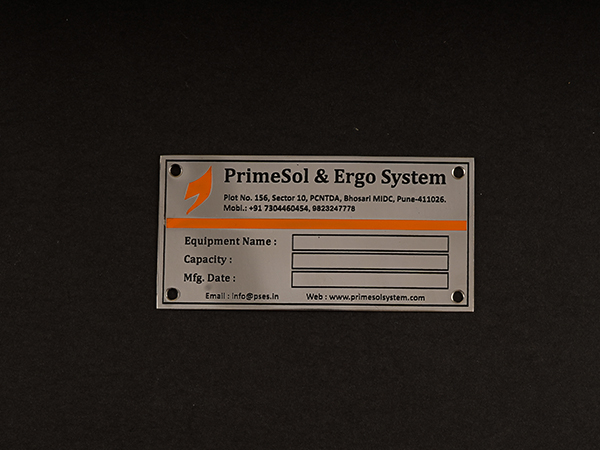 | Metal Labels In the most testing conditions, particularly overwhelming modern situations, where heat, moisture and erosion are available, Stainless Steel... View product → |
Frequently asked questions
Is in-mold decoration a stainless steel nameplate process?
No. IMD places printed thermoplastic film inside an injection mould and bonds it to an injected polymer part. Stainless steel nameplates use separate marking or finishing methods.
When does IMD suit Mumbai conditions?
IMD suits applications that need graphics integrated into a formed polymer surface and exposed to handling, humidity, dust or routine cleaning. Confirm resistance against the actual cleaners, temperatures and outdoor exposure.
How does IMD compare with stainless steel marking alternatives?
IMD combines the graphic with a moulded plastic surface and supports three-dimensional forms. Etching, engraving, laser marking, screen printing and adhesive labels remain options when you need a metal plate, exposed-metal appearance or a different durability profile.
What details should you specify when buying a durable nameplate?
State the material or steel grade, surface finish, graphic method, dimensions, fixing method, adhesive or fasteners, cleaning chemicals, temperature range, humidity and salt exposure, and required abrasion or adhesion tests.