

A pressure-sensitive sticker applied after molding is not equivalent to a printed film insert placed inside the mould. The substrate, ink, adhesive, resin, temperature, pressure and mould design must work as one system, and the preparation process changes before production begins.
Key takeaways
- Treat post-mold adhesive stickers as separate from in-mold labels.
- Start sticker preparation with the finished part’s geometry and moulding conditions.
- Test film, ink, adhesive and resin together through the complete mould cycle.
- Compare PVC and polycarbonate constructions, not film names alone.
A sticker applied after molding is not an in-mold label
A self-adhesive label applied to a finished part bonds to a cooled surface through pressure-sensitive adhesive. It remains a separate layer, with its own adhesive, edge and application step.
A printed polycarbonate film insert placed in the cavity before injection becomes part of the molded surface: resin contacts the insert, bonds to it or locks around its features, then cools against it.
The phrase PVC or polycarbonate stickers before in mold decoration hides three different constructions. Confirm which one you are buying:
- A self-adhesive PVC or polycarbonate sticker is normally applied after molding. Its adhesive must wet the finished surface and resist later lifting.
- A printed film insert is printed, cut and positioned before resin enters the mold. It is not automatically suitable just because the film is polycarbonate.
- A true in-mold label is designed for cavity placement and resin contact, often without the paper release liner used with pressure-sensitive labels.
The mold changes too. Locating pins, retaining features, suitable corner radii and controlled venting hold the insert flat and let trapped air escape. Without them, injection pressure can wrinkle the film, force resin under an edge or leave silvering.
A label that passed inspection alone can still fail after molding through distortion, edge lift or colour change. PVC also needs deliberate resin and temperature matching; it is not a drop-in substitute for a purpose-designed insert.
The sticker preparation process starts with the finished-part geometry
Map the finished-part geometry before preparing any film. The sticker preparation process must account for curves, corners, draw depth, ejector marks, gate locations and the area available for mold placement; a flat label outline is not enough.
1. Convert the approved CAD surface into a flat pattern and mark registration features, trim allowance and any no-print zones.
2. Compensate the artwork for stretching or compression during thermoforming. Check logos and small text on a formed sample, because a correct flat file can become elongated or visibly out of register.
3. Select film grade and thickness for the resin, forming method and mold cycle. Confirm whether “sticker” means a pressure-sensitive label or a printed film insert.
4. Treat the print surface with the specified corona, plasma, primer or resin-specific adhesive system. A surface-energy reading alone does not prove adhesion.
5. Print the artwork in the correct layer order, then cure or dry each ink system fully. Uncured ink can smear, change colour or delaminate under resin contact.
6. Thermoform the printed sheet when the part requires depth, then inspect distortion against the approved sample.
7. Die-cut the insert to its compensated profile, keeping clean edges and registration features. For true in-mold placement, remove the paper release liner; do not confuse it with a post-mold self-adhesive label.
8. Clean, inspect and store inserts flat with protective interleaving. Reject wrinkles, scratches, contamination, edge lifting and print defects before loading the mold.
Test the complete printed stack after forming and molding, not just the film or artwork separately.
Film, ink, adhesive and resin must survive the same mould cycle
An insert must survive the peak mould temperature, injection pressure, resin chemistry, cooling contraction and ejection—not merely adhere to a room-temperature panel. Polycarbonate offers impact resistance, dimensional stability and a useful thermoforming window, but a self-adhesive PC label is not automatically an IMD insert.
PVC needs closer matching of film, ink, adhesive and resin, especially in high-temperature or long-residence cycles.
Watch for these failure points during trials:
- Heat can soften PVC, distort the image or drive dehydrochlorination, causing discoloration, odour and corrosion from hydrogen chloride.
- Injection pressure can force resin under a weak edge, lifting the film or creating wrinkles.
- Resin contact can attack the adhesive or ink, while poor surface bonding leaves blisters and delamination.
- Cooling makes the resin and insert contract at different rates; that mismatch produces curl, stress whitening or edge lift.
- Demoulding can scratch the printed face, stretch a softened film or pull an inadequately anchored insert from the cavity.
For polycarbonate stickers in mold decoration, specify whether you mean a pressure-sensitive label or a printed, die-cut PC film insert. The latter may be thermoformed and normally enters the mould without its paper release liner; injected resin bonds to or mechanically locks against its prepared surface.
Condition PC film, carriers, inks and adhesives before processing. Mumbai’s monsoon humidity increases moisture pickup, so use sealed packaging, controlled storage and limited open-room exposure. Approve the complete molded part after temperature, pressure, cooling and demoulding trials—not the sticker alone.
PVC versus polycarbonate: compare the complete construction, not just the film
Choose PVC when the part needs a lower-cost, flexible insert and the resin cycle is mild enough to protect the film, ink and bonding layer. Choose polycarbonate when impact resistance, dimensional control, thermoforming or a premium control-surface finish matters. In both cases, compare the complete construction, not the substrate alone.
| Option | Complete construction | More practical choice |
|---|---|---|
| PVC insert | Printed PVC film, cured ink, compatible adhesive or bonding coat, and die-cut geometry; flexibility helps on simple contours but heat and shrinkage can cause distortion or edge lift. | Shorter runs, flatter parts, moderate-temperature cycles and applications where cost and easy handling matter. |
| Polycarbonate insert | Printed PC film, cured ink, optional hard coat, tie layer or mechanical retention; the film handles impact and forming better, but moisture and resin compatibility demand tighter control. | Complex surfaces, durable control panels and PC-over-PC molding, after testing the exact resin and bond system. |
| Pressure-sensitive label | Film, printed layer, adhesive and release liner; this is usually applied after molding, not inserted before injection. | Identification work where post-mold application is acceptable, not automatic IMD. |
For polycarbonate stickers in mold decoration, specify whether “sticker” means a self-adhesive label or a printed film insert. The former does not prove the adhesive will survive injection pressure, resin contact or demoulding.
For PVC stickers in mold decoration in Mumbai, sealed storage, short exposure during monsoon humidity and supplier-specified conditioning reduce moisture-related failures. Dry PC film and resin separately to their data-sheet instructions; wet material can cause bubbles, splay, silver streaks and weak bonding. Protect presses, racks and tooling from coastal corrosion.
When requesting samples, Shreeniwas Signs Pvt Ltd should receive the molding resin, cycle conditions and part drawing so the quoted construction matches the actual insert rather than just the film.
Related product
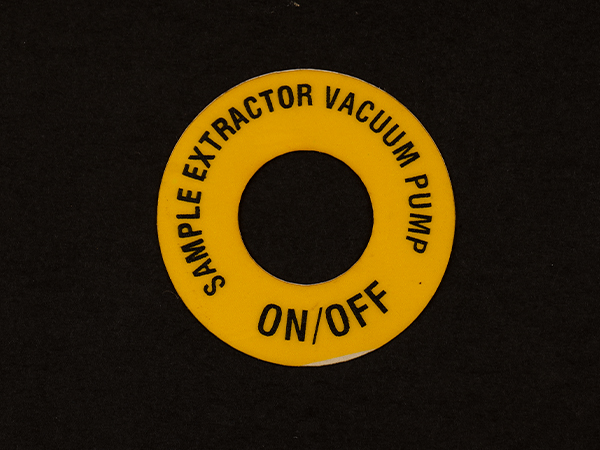 | Plastic Labels PVC & Polycarbonate Stickers are often used in various industries. View product → |
Choose the production method after testing the complete molded part
Make the decision on the fully molded, tested part, not on a loose film sample. A “polycarbonate sticker” could mean a self-adhesive identification label applied afterward or a printed PC film insert placed in the mould; those constructions are not interchangeable.
| Method | What it means | Choose it when |
|---|---|---|
| Post-mold adhesive application | Apply a pressure-sensitive PVC or PC label after molding | You need variable data, short runs, late design changes or easy replacement |
| In-mold film decoration | Print, form and place a film insert before injection | You need a durable graphic integrated into the surface and can accept tooling and insert-control costs |
| In-mold labeling | Position a pre-printed label in the mould; resin bonds to or locks against it | You need high-volume repeatability, no release liner and a label matched to the molding resin |
| Direct printing | Print ink directly on the molded substrate | The surface is accessible, graphics are simple and the substrate accepts the ink system |
Test the complete part through the actual production cycle, then check:
- Registration, wrinkles, bubbles, edge lift and colour change
- Adhesion after cooling, abrasion, cleaners, heat and humidity
- Part dimensions, demoulding damage and assembly fit
- Rejection rate, die-cut waste, insert-placement time and mould-modification cost
In plastic label production, the cheapest film can create the highest total cost when it causes rework. Choose the method with the best tested yield and end-of-life fit; declare the film, ink, adhesive and resin together when recycling matters.
Frequently asked questions
Is a sticker applied after molding an in-mold label?
No. A post-mold sticker bonds to a cooled part with pressure-sensitive adhesive and remains a separate layer. An in-mold label is placed inside the mould before resin is injected.
What starts the sticker preparation process for in-mold decoration?
Start with the finished-part geometry. Check curves, corners, draw depth, label position, mould access and how the label will be held during injection.
What must survive an in-mold decoration cycle?
The film, printed ink, adhesive, label edges and moulding resin must withstand the same heat, pressure, flow and cooling cycle without lifting, distortion or print damage.
Should you choose PVC or polycarbonate by film name alone?
No. Compare the complete construction, including film grade, ink system, adhesive or bonding layer, thickness, surface finish and compatibility with the resin and mould cycle.