
The right choice depends on whether the equipment needs a control surface or only a permanent identification plate. By comparing construction, failure risks, service demands and replacement effort, you can decide when an overlay earns its cost and when stainless steel remains the better specification.
Key takeaways
- Use graphic overlays for controls operators press, read or view.
- Use stainless steel nameplates for fixed identification and harsh exposure.
- Test adhesive, print, switches, edges and cleaning chemicals before approving an overlay.
- Compare replacement access and downtime, not just material service life.
Start with the job: control surface or fixed identification plate?
Choose a graphic overlay when operators repeatedly press, read or view the control panel. Choose a stainless steel nameplate when the part only identifies equipment and must withstand handling, cleaning or outdoor exposure.
A graphic overlay is a printed polyester or polycarbonate user-facing film placed over buttons, displays, indicator windows and control-panel openings. One part can combine legends, membrane-switch keys, transparent areas, backlighting and tactile features. A stainless plate is a rigid marking substrate for a fixed asset tag, rating plate, serial plate or outdoor identification plate.
| Option | What it does | Best choice |
|---|---|---|
| Graphic overlay | Combines interface graphics, keys, windows and tactile functions | Operator-facing control panels |
| Stainless steel nameplate | Provides rigid, readable equipment identification | Asset, rating and serial plates |
| Graphic overlay versus stainless steel nameplates | Matches construction to use rather than choosing plastic or metal by habit | Compare the job, exposure and interaction |
For “are graphic overlays worth it instead of stainless steel nameplates in Mumbai,” select the overlay for an actively used interface, especially where backlighting, fine artwork or tactile controls matter. Select stainless steel for identification that must remain legible through abrasion, cleaning, impact or outdoor exposure.
The decision is function-led: a control surface and a fixed identification plate solve different problems.
Compare the overlay construction, not just polyester with polycarbonate
Film grade, ink system, laminate and adhesive change the result more than the polymer name alone. Compare these details before choosing between graphic overlays versus stainless steel nameplates.
| Construction | Abrasion, cleaning and stability | Impact, forming and feel |
|---|---|---|
| Polyester film | Strong abrasion resistance, cleaning durability and dimensional stability | Less suited to deep forming or impact-heavy surfaces |
| Polycarbonate film | Adequate performance depends on grade and protection | Better impact resistance, forming capability and a more tactile surface |
For durable graphic overlays, ask whether mounting uses face adhesive or adhesive-backed mounting, and whether the graphics are reverse-printed beneath the film or exposed on its face. Specify clear windows, tactile domes, embossing, die-cut openings and a protective coating.
Reverse printing keeps graphics away from rubbing and routine wiping; exposed edges, cut-outs and poor lamination remain vulnerable to lifting, bubbling and moisture entry.
Name the actual mounting surface: powder-coated metal, painted steel, textured plastic, glass or bare metal. State the minimum application temperature, service-temperature range, humidity conditions and chemical-cleaning exposure. An adhesive that holds on smooth painted sheet can fail on textured powder coat or low-surface-energy plastic.
Ask for the adhesive grade and preparation method, not merely an “industrial” claim. A face laminate can protect the print while leaving an unsealed cut-out as the first failure point.
Test the failure points before calling an overlay durable
A “durable” claim proves little until the overlay survives the forces your equipment will impose. Test the exact construction on the exact substrate, then inspect failures rather than accepting a generic industrial-grade description.
1. Request test evidence for abrasion, the cleaning chemicals you use, oils, UV exposure, humidity, temperature cycling, fingerprints and repeated key presses. Ask for test methods, exposure levels, cycle counts and pass criteria, not just the words “tested” or “industrial grade.”
2. Inspect samples after testing for edge delamination, bubbling, lifted corners, scratched print, yellowing, embrittlement, loss of tactile definition and adhesive failure. Reverse printing protects graphics beneath the film, but exposed edges, cut-outs and poor lamination remain vulnerable.
3. For outdoor equipment, require evidence for the complete construction: film, inks, adhesive and clear coat or laminate. A substrate-only UV claim is insufficient because pigments, print side, exposure angle and climate affect fading, yellowing and embrittlement.
4. Treat an IP rating as a property of the complete enclosure or assembly, not automatically of the overlay. Cut-outs, gaskets, screws, corner radii and installation determine whether dust or water enters.
5. UL 969 listing or testing supports marking permanence under specified conditions. It does not guarantee that durable graphic overlays will survive every Mumbai chemical, abrasion level or outdoor environment; match the evaluated construction to your use.
6. Record the exact service conditions before approval: chemicals, temperature, humidity, UV duration, substrate and replacement interval. That record exposes weak evidence before it becomes a failed control panel.
Compare service life, cleaning and replacement effort in the installed machine
Stainless steel usually lasts longer on plates exposed to repeated abrasion, hot cleaning, aggressive solvents or occasional impact. It does not depend on a flexible printed face, but an adhesive-mounted plate can still detach from oily, rough or curved surfaces.
It also creates glare, cannot incorporate tactile controls and takes more time to remove and replace on site.
| Option | Service and cleaning | Replacement and design |
|---|---|---|
| Stainless steel | Grade 304 suits general industrial identification; 316 or 316L is better for chloride exposure and salt-laden Mumbai conditions. | Suits low-volume serial, rating and asset plates, but offers no backlighting, windows or integrated keys. |
| Graphic overlay | Handles multicolour artwork, fine graphics, windows, backlighting, tactile keys and several panel labels in one part. | Easy to change as a panel part, but becomes uneconomic for frequent artwork changes, very small quantities or poorly controlled installation. |
| Other stainless steel nameplate alternatives | Anodized aluminium is light and clean-looking but less suitable for severe abrasion or chlorides. Engraved or laser-marked plastics are lighter, yet depend on the plastic grade and exposed mark. | Useful for controlled indoor applications, not a universal substitute. |
Stainless is not corrosion-proof. Salt deposits, stagnant moisture, carbon-steel contamination and poor cleaning cause tea staining or crevice corrosion; specify clean fabrication, passivation and rounded or sealed edges. Overlays need a clean, smooth mounting surface and careful installation, or lifted corners and failed adhesion can erase their replacement advantage.
Compare these factors when reviewing equipment identification options in Mumbai.
Use a decision checklist before requesting a quote
Turn the comparison into a purchase specification before requesting a quote. For the question, “Are graphic overlays worth it instead of stainless steel nameplates in Mumbai?”, state the part’s job, not just its material.
| Option | Best fit | Main specification risk |
|---|---|---|
| Graphic overlay | Operator-facing controls, windows or keys | Adhesive, print and edge failure |
| Stainless steel | Fixed identification or rating plate | Glare, corrosion or poor replacement access |
Specify:
- Part type: control overlay, rating plate, serial plate or safety marking.
- Service life, indoor or outdoor exposure, UV duration, cleaning chemicals and abrasion method.
- Operating temperature, substrate, adhesive type, application temperature and humidity.
- Minimum legibility, serialisation method and replacement strategy.
- Exact construction: film grade, ink position, laminate or clear coat, windows, openings, embossing and tactile features.
For safety markings, define contrast, symbol, text size, placement and permanence against ISO 3864, ISO 7010 or ANSI Z535, as applicable. Both overlay and metal can meet that need. Ask for complete-construction test evidence, including film, ink, adhesive and coating; a generic “industrial grade” claim or substrate-only UV claim proves little.
UL 969 evidence applies only to the evaluated marking system and conditions.
Shreeniwas Signs Pvt Ltd can help compare a control-panel overlay and metal identification plate against the same drawing, substrate and exposure conditions. Stainless steel nameplate alternatives still require the same tests.
Select a graphic overlay for an operator-facing interface; select stainless steel for a fixed plate whose priority is rugged, readable identification.
Related products
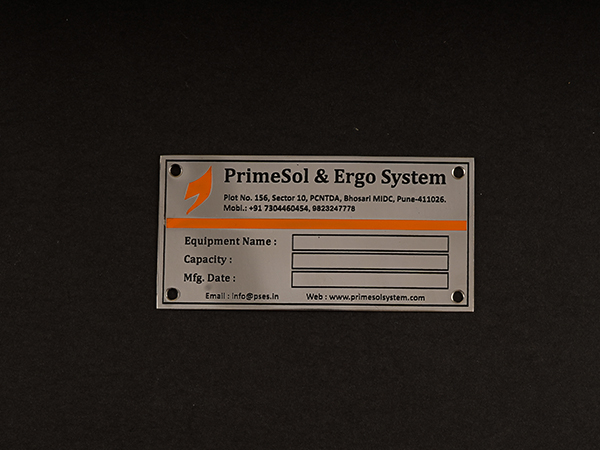 | Metal Labels In the most testing conditions, particularly overwhelming modern situations, where heat, moisture and erosion are available, Stainless Steel... View product → |
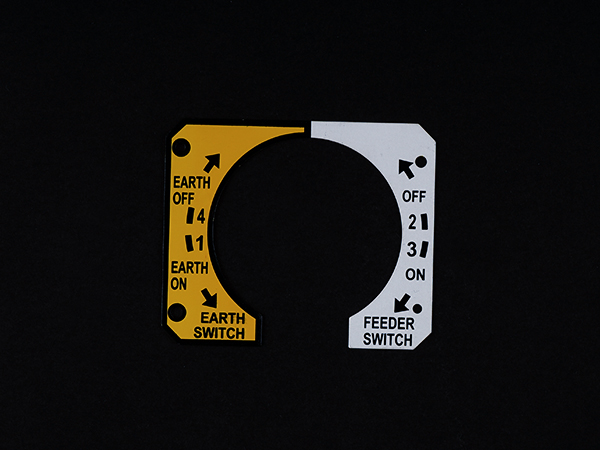 | Metal Labels A Control Panel Nameplate a flat, regularly vertical, region mounted on machine where control or observing instruments information are shown They are... View product → |
Frequently asked questions
When should you choose a graphic overlay instead of a stainless steel nameplate?
Choose a graphic overlay for an active control surface with buttons, legends, indicators or display windows. Choose a stainless steel nameplate for fixed equipment identification.
What should you compare in graphic overlays versus stainless steel nameplates?
Compare the full construction: face material, printed graphics, adhesives, tactile features, windows, cut-outs, mounting method and substrate compatibility.
Which failure points should you test before approving a durable graphic overlay?
Test print abrasion, chemical exposure, edge lifting, bubbling, switch operation, window clarity, adhesive bond and repeated cleaning on the installed surface.
How do cleaning and replacement affect the choice?
Assess the machine’s cleaning chemicals, temperature, moisture, handling and access for replacement. A lower-cost overlay can create more downtime if the control panel is difficult to remove.
Related product
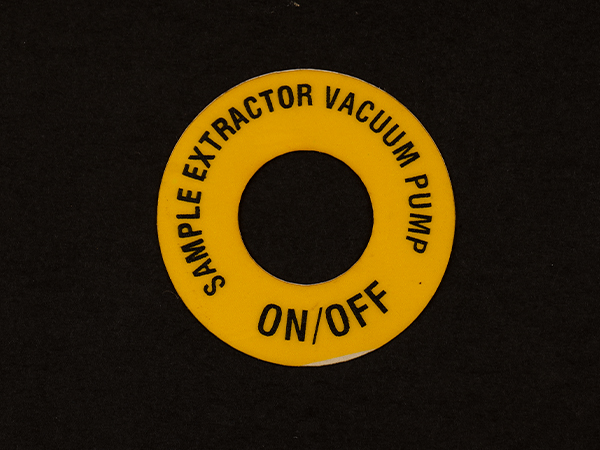 | Plastic Labels PVC & Polycarbonate Stickers are often used in various industries. View product → |