

The right interior sign depends on more than appearance: the wall surface, cleaning routine, contact level, replacement plan and mounting method all affect the result. By comparing PVC, polycarbonate and verified brass products against those conditions, you can choose a finish that remains readable, maintainable and consistent across your Mumbai workplace.
Key takeaways
- Use brass for statement areas; choose PVC or polycarbonate for replaceable office labels.
- Match adhesive and thickness to paint, glass, laminate or textured walls.
- Check contrast, letter size, tactile features and mounting height before ordering.
- Compare cleaning resistance, replacement effort and installation cost over the sign’s life.
Choose the material by sign location, not by material popularity
Reception signs and lift-lobby identification suit brass when you want a substantial engraved, etched, brushed or polished-metal statement. Room names, desk labels and directional signs usually favour PVC or polycarbonate, depending on wear and replacement needs.
| Option | Best interior locations | Main advantage | Main drawback |
|---|---|---|---|
| PVC sticker | Desk labels, room names, temporary directions, broad wall graphics | Economical, flexible, easily die-cut, printed and replaced | Lifts on rough paint and wears under abrasion |
| Polycarbonate plate | Cart routes, equipment-adjacent labels, frequently handled room signs | Rigid, dimensionally stable and more resistant to knocks | Costs more than PVC; uncoated faces can scratch |
| Brass nameplate | Reception, executive rooms and lift lobbies | Premium visual signal with engraved or etched metal character | Adds weight, cost and cleaning or polishing maintenance |
PVC stickers for offices in Mumbai work well on smooth, sound paint, glass, laminate, acrylic, doors and powder-coated metal after proper cleaning. A laminated face is worth specifying where housekeeping repeatedly wipes the graphic. PVC is usually the easiest material to replace without drilling or remounting a plate.
For PVC polycarbonate stickers or brass nameplates for business interiors in Mumbai, choose by the damage the sign will face:
- Avoid a sticker on rough, dusty or flaking paint; the adhesive will follow the failure underneath.
- Avoid unprotected plastic where carts, bags or repeated hand contact will abrade it.
- Avoid brass when a lightweight, removable, low-maintenance sign is the priority.
Match the face, thickness and adhesive to the interior surface
A sign lifts because the fixing system does not suit the surface, not because the printed face is automatically wrong. Specify the exact substrate: painted drywall, glass, wood, laminate, powder-coated metal, acrylic, a door or an uneven wall.
| Fixing option | Advantage | Limitation |
|---|---|---|
| Thin transfer adhesive | Flat appearance and minimal edge shadow | Needs a smooth, clean surface and even pressure |
| Acrylic foam tape | Accommodates small irregularities | Creates stand-off and a visible edge shadow |
Test the chosen adhesive on that exact finish after removing dust, grease and uncured paint residue. Apply firm, uniform pressure, then allow the adhesive to cure for the tape manufacturer’s stated time before judging performance; early loading can cause peeling.
Specify a rounded corner radius rather than sharp square corners. Rounded corners reduce edge lift and local stress, especially on flexible PVC stickers, while a rigid plate needs a defined thickness, edge finish and flexibility limit.
For polycarbonate business labels in mumbai, record the plate thickness, face finish and removal method. Thin stickers are easier to replace but can curl on uneven walls; thicker plates need stronger fixing and can damage paint during removal.
Use drilling, standoffs or concealed mounts only with a site template. They demand accurate alignment, suitable wall anchors and a plan to repair holes when the sign moves. Test removal on a spare painted panel before approving a permanent installation.
Compare appearance, cleaning resistance and maintenance over time
PVC and polycarbonate retain printed colour and graphics, while brass delivers an engraved, etched, brushed or polished-metal appearance. Their ageing patterns differ:
| Option | After sunlight and humidity | After contact and cleaning |
|---|---|---|
| PVC sticker | Window sunlight can fade exposed ink; Mumbai monsoon moisture exposes weak edges and adhesive. | Fingerprints wipe away, but repeated alcohol wipes, quaternary-ammonium disinfectants, detergents or glass cleaners can abrade or attack unprotected print. |
| Polycarbonate sticker | Better rigidity and impact resistance, but sunlight can still affect colour and humidity can reveal edge or adhesive failures. | Uncoated polycarbonate scratches; solvents can cause stress cracking around sharp corners, drilled holes and formed areas. |
| Brass nameplate | Solid brass develops darker tones or patina as oxygen and moisture react with the surface. | Fingerprints show clearly. A polished face reveals marks faster than a brushed or etched face, and cleaner compatibility depends on the lacquer or finish. |
Specify a laminate for PVC wherever staff repeatedly wipe the sign. It protects ink from abrasion and chemical attack, but changes gloss, colour appearance and apparent edge thickness; test the proposed laminate with the actual alcohol wipe, disinfectant, detergent and glass-cleaner routine.
For brass office nameplates in Mumbai, choose clear lacquer when you want slower tarnishing and less routine polishing. Touch points eventually wear through the lacquer, creating uneven darkening. Choose unlacquered brass only with a defined polishing schedule, because fingerprints and patina are part of its appearance rather than defects.
Air-conditioning slows neither handling marks nor poor cleaning compatibility.
Make the sign readable, accessible and consistent across the workplace
1. Set a readable baseline: use 100 × 30 mm minimum for a desk label, 200 × 100 mm for a room plaque, and 300 mm or wider for a directional sign viewed down a corridor.
Use 12–16 mm letter height for room names at 3–5 m, larger type when the sign is read from farther away. Specify dark text on a light face, or white text on a dark face, and check contrast in the installed lighting.
2. Use a 3 mm rigid plate for room plaques, with a 3–5 mm corner radius and a satin, low-glare finish. Mount its centre around 1,400–1,600 mm above finished floor level, using concealed fixings or a rigid adhesive mount.
A polished brass plate can still fail if glare hides the text or the plaque flexes, shifts or sits too high.
3. Treat accessibility separately from visual styling. Specify raised lettering and Braille using the applicable accessibility standard, with tactile characters positioned consistently and tested by touch. Do not assume engraved grooves are tactile lettering.
A desk label needs a replaceable insert or face when occupants change; a room plaque needs a fixed mount when alignment and accessibility depend on its position.
4. Apply one system to reception identification, room plaques, fire-exit directions, washroom signs and equipment labels: the same typeface, colour logic, icon style, corner radius and finish. Approve a physical proof for colour, engraving depth, infill colour and every spelling before production.
Directional and washroom signs become confusing when arrows, icons or contrast change from floor to floor.
Verify the material, installation and lifetime cost before ordering
Compare quotations on the approved sample and total project scope, not the lowest unit price. For PVC stickers for offices in Mumbai, polycarbonate business labels in Mumbai and brass office nameplates in Mumbai, require the supplier to state the exact base material.
| Option | What the quotation must identify | Cost risk to check |
|---|---|---|
| Solid brass | Engraved, etched, brushed or polished metal; weight and tarnish protection | Heavier mounting and higher replacement cost |
| Brass-plated steel | Plated steel core, edge finish and corrosion protection | Plating wear can expose the base metal |
| Brass-colour anodised aluminium | Anodised finish and marking method | Colour and engraving depth may differ between batches |
| Brass-look printed laminate | Printed surface, protective layer and edge construction | Wear, cleaning damage and colour mismatch |
Ask for physical material samples, a colour and finish proof, an adhesive sample, corner radius, thickness, mounting method, cleaning compatibility, installation scope and the future replacement process. Confirm whether brass text is mechanically engraved, chemically etched, digitally printed or marked on a coating. Laser marking does not produce the same result on every stock.
Compare peel-and-stick fitting with screws, standoffs and concealed fixing. Price templates, alignment across doors, drilling, removal and wall repair separately. Evaluate service life, replacement frequency, repairability and whether later batches will match.
Shreeniwas Signs Pvt Ltd can coordinate labels, nameplates, proofs and installation details across Mumbai sites, but your purchase order should remain tied to the approved specification and sample.
Related product
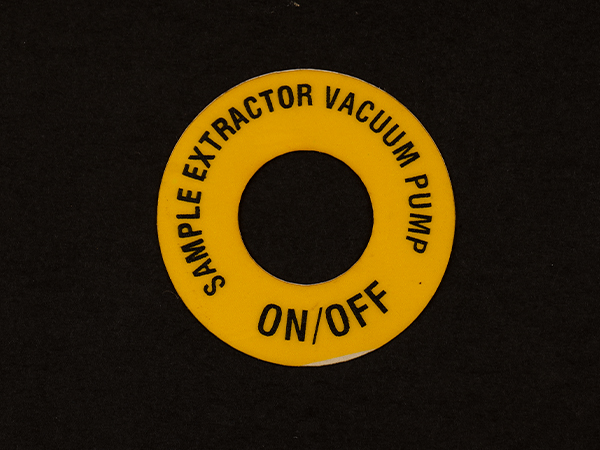 | Plastic Labels PVC & Polycarbonate Stickers are often used in various industries. View product → |
Frequently asked questions
Where should you use brass nameplates instead of PVC or polycarbonate stickers?
Use brass for reception signs and lift-lobby identification when you want an engraved, etched, brushed or polished-metal statement. Use PVC or polycarbonate for room names, desk labels and directional signs when replacement or lower weight matters.
How do you match an interior sign to its mounting surface?
Choose the adhesive and sign thickness after identifying the surface: painted wall, glass, laminate, metal or textured finish. Clean and dry the surface, then confirm that the adhesive suits its texture and cleaning routine.
Which material is easier to maintain in a busy office?
Compare the face finish, resistance to cleaning chemicals, scratch risk and replacement process. Polycarbonate suits labels exposed to handling, while PVC suits applications where economical replacement matters; brass suits areas where the finish is part of the interior design.
What accessibility details should business interior signs include?
Check visual contrast, readable letter height, consistent placement and clear directional wording. Add tactile lettering or Grade 2 Braille where your building requirements and accessibility plan call for it.