

A brass plate becomes useful in a control panel only when its information, dimensions, fixing method and finish match the panel design and operating environment. By following the drawing, approval, fabrication and inspection sequence, you can decide where brass adds value and where another substrate will perform better.
Key takeaways
- Match every legend to the schematic, bill of materials and approved specification.
- Add plate dimensions, hole centres, corner radius and fixing method to the drawing.
- Choose etched, engraved or photo-marked brass based on wear, detail and environment.
- Approve a first-off sample before releasing the full Mumbai production order.
What information belongs on a brass control panel nameplate?
In brass nameplates control panel production in Mumbai, choose the content from the approved panel documents before artwork starts. Every legend must match the schematic, bill of materials, inspection record and customer specification; a wrong tag is a functional quality failure.
Information falls into three groups:
- Identification: equipment tag, panel designation, asset or serial number, and manufacturer name.
- Safety and rating: voltage, current, enclosure rating, and warning text.
- Maintenance: feeder or wiring references, terminal identifiers, and revision number.
| Category | Typical content | Main check |
|---|---|---|
| Identification | Panel P-101, serial number, manufacturer | Matches drawing and asset record |
| Safety | 415 V, 32 A, IP54, “Isolate supply” | Uses specified language, contrast and location |
| Maintenance | Feeder F-03, terminals X1:1–X1:12, Rev B | Matches schematic and inspection record |
Apply IEC 60204-1 to electrical equipment of machines and IEC 61439 to low-voltage switchgear and controlgear assemblies. For a UL-regulated market, verify the label system and end-product requirements under UL 969 before selecting ink, adhesive or clear coat.
Brass is a substrate, not proof of compliance. A decorative plate cannot replace a required safety marking. Use the language operators understand, high contrast, permanent marking and a location readable during operation or maintenance. Keep warnings beside the hazard or control they describe, not where a door, cable or glare hides them.
How the control panel nameplate process moves from drawing to first-off sample
The control panel nameplate process moves from a controlled drawing and text schedule to an approved first-off sample before batch production. This order matters: a changed tag, reversed legend or missing revision after marking can create scrap, not a simple text edit.
1. Lock the panel drawing revision and text schedule. Compare equipment tags, warnings, ratings and terminal references with the schematic, bill of materials and inspection records.
2. Prepare artwork showing plate outline, text, revision, colour, holes or adhesive zones. Raise supplier questions about unclear characters, missing dimensions or conflicting references, then obtain customer proof approval before engraving, chemical etching or screen preparation.
3. Select the brass grade, surface finish and nominal thickness. Record these choices in the industrial panel nameplate manufacturing specification.
4. Cut or shear the plate, deburr every edge, and prepare the surface. Remove oil and oxidation before marking; contamination can cause weak ink adhesion or uneven etching.
5. Engrave, chemically etch or screen print the approved artwork. Apply colour filling where specified, then cure it and add the protective coating. A revised legend at this stage usually means remaking the plate.
6. Drill holes, countersinks or mounting clearances, or apply the specified rear adhesive. Inspect dimensions, hole pitch, burrs, legend content, character clarity, fill adhesion, coating defects and adhesive placement.
7. Check the first-off sample against the approved revision before releasing the batch. Pack plates to prevent scratches, record quantity, and install them with the correct orientation and clearance from controls and live parts.
Retain the approved artwork, material and thickness details, first-off approval and inspection results with the production record.
Which dimensions and fixing details must be on the panel drawing?
Put the finished plate size and every fixing reference on the panel drawing before artwork approval. Specify:
- Finished width and height, nominal thickness, alloy or material grade, finish and marking method
- Corner radius, border width, character height and dimensional tolerances
- Hole diameter, hole pitch, hole edge distance and countersink diameter and depth
- Adhesive area, mounting clearance and intended indoor, outdoor or wash-down service
The drawing must locate switches, lamps, meters, selector controls, ventilation slots, control cut-outs, hinges and door edges. That is how brass nameplates fit into control panel nameplate production in Mumbai without covering an opening, blocking a control or fouling the door.
Fixing choice depends on the enclosure and service conditions:
| Option | Strength and limitation | Use when |
|---|---|---|
| Drilled screws or rivets | Secure, removable with tools; holes penetrate the enclosure | The plate faces heat, oil, washing or removal |
| Countersunk holes | Flush hardware; reduced edge thickness around the hole | Door clearance matters and the panel can accept drilled holes |
| Standoffs | Creates clearance behind the plate; hardware can approach live parts | A rigid air gap is required, after electrical review |
| Rear adhesive | No visible hardware; depends on surface preparation and temperature | The powder-coated or textured surface is sound and removal is not expected |
For adhesive, name the adhesive family, minimum application temperature, service-temperature range, surface preparation, and dwell or cure time. Check clearances from live parts, exposed busbars and uninsulated terminals before approving metal hardware or plate edges.
When is brass the right production material, and which marking method fits it?
Choose brass when appearance, engraved durability and equipment identity matter more than low weight or lowest cost. Specify the alloy or supplier designation, such as C26000 cartridge brass, nominal thickness, temper, surface finish, background and text colour, protective coating and required viewing distance. “Brass finish” could mean coated aluminium, not solid brass.
For custom brass labels in mumbai, state whether the plate faces humid air, coastal salt, coolant, rain, cleaning chemicals, abrasion, heat or frequent operator contact. Bare brass tarnishes through oxidation and handling; clear lacquer preserves its initial appearance but can yellow, scratch, or fail at edges and drilled holes.
Prioritise contrast and marking depth when legibility matters more than polish.
| Method | Groove or image | Fine detail, colour and durability | Best fit |
|---|---|---|---|
| Rotary engraving | Mechanically cut groove; fillable | Strong wear resistance; limited by cutter size; repeatable; paint curing affects filled areas | Touch-heavy plates needing deep, high-contrast legends |
| Chemical etching | Recessed, shallow graphics | Fine detail and repeatability; broad colour options with fill; coating and fill affect wear | Dense legends and serial plates |
| Screen printing | Surface ink layer | Large colour areas and repeated designs; ink needs surface preparation and curing; abrasion resistance depends on ink | High-volume identical plates |
| Filled engraving | Deep groove with contrasting paint | High contrast and wear resistance; fill width limits small text; curing affects consistency | Operator-facing labels requiring emphasis |
Proof artwork at production scale. Tiny strokes can close during etching, disappear during filling, or become unclear beneath clear coat.
Choose stainless steel for severe chemicals or salt, anodized aluminium for lighter durable plates, aluminium when weight matters, and polycarbonate for impact or electrical-interface applications. Brass is the wrong choice when tarnish, coating failure or chemical exposure threatens readability.
How should a Mumbai production order be approved, inspected and installed?
A Mumbai order is approved against documents, not a finish sample. The technical specification for brass nameplates control panel production in Mumbai remains unchanged; local coordination confirms plant access, delivery quantities, installation sequence and site-specific surface conditions.
1. Record the panel drawing revision and issue the text schedule. Include every equipment tag, warning, rating and terminal reference.
2. Mark each plate location on the panel layout, including orientation and fixing method. Check doors, controls, vents, hinges and live-part clearances.
3. Approve full-scale artwork against the schematic, bill of materials and customer specification. A changed tag after etching or engraving creates scrap.
4. Sign off one first-off sample before releasing the batch for cutting, marking, filling, coating and hole or adhesive preparation.
5. Inspect incoming custom brass labels in Mumbai against the approved revision. Check the alloy or material certificate, thickness, dimensions, hole pitch, burrs, sharp edges, legend content, character clarity, fill adhesion, coating defects, adhesive placement and quantity.
6. Install plates in the approved orientation. Confirm secure fixing, clearance from live parts and exposed busbars, and unobstructed switches, meters and controls.
Shreeniwas Signs Pvt Ltd belongs on a supplier comparison when the buyer provides the approved drawing, environmental conditions and fixing requirements rather than ordering by finish alone.
Retain this handoff record:
- Approved artwork revision and panel drawing revision
- First-off sample approval
- Material certificate and inspection results
- Delivered quantity and installation sign-off
Related product
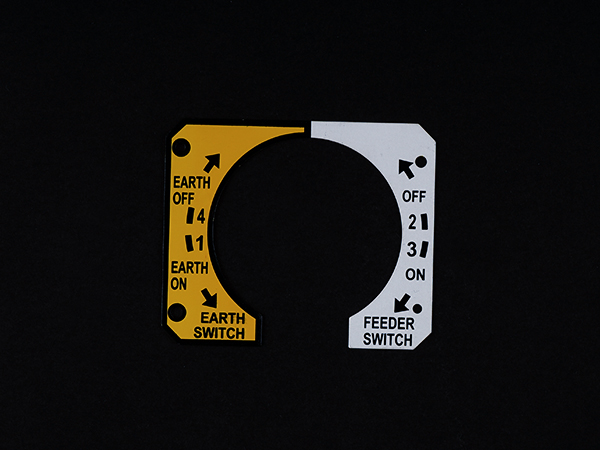 | Metal Labels A Control Panel Nameplate a flat, regularly vertical, region mounted on machine where control or observing instruments information are shown They are... View product → |
Frequently asked questions
What information belongs on a brass control panel nameplate?
Include the equipment or panel identifier, component tag, function, warning text, ratings and required symbols. Check every legend against the schematic, bill of materials, inspection record and customer specification before artwork approval.
What details must the panel drawing show?
Show plate length and width, thickness, corner radius, hole diameter, hole-centre locations, fixing method, text orientation, border position and clearance from panel edges. Mark whether the plate uses screws, rivets, adhesive or another specified fixing method.
How does the control panel nameplate process move from drawing to first-off sample?
Release the approved content and panel drawing, prepare artwork, confirm the brass grade and marking method, produce one first-off sample, then inspect its dimensions, text, colour, finish, hole positions and readability before approving the batch.
When is brass the right material for a control panel nameplate?
Choose brass when you need a rigid, premium-looking plate with durable identification and the installation environment suits its weight, finish and corrosion conditions. Select etched, engraved or photo-marked brass according to required detail, contrast, wear resistance and cleaning exposure.