

Rain is only one part of the decision: prolonged humidity, wet–dry cycling, coastal chlorides, UV, windblown dust and failed adhesive bonds all affect label life. By comparing the two constructions by location and exposure, then checking the complete specification and installation method, you can choose a label that stays legible through Mumbai’s monsoon rather than judging the face material alone.
Key takeaways
- Choose brass for rigid permanent assets and polycarbonate for curved or operating surfaces.
- Specify UV laminate, sealed edges and outdoor adhesive for monsoon exposure.
- Clean, dry and abrade the mounting surface before installing labels before the rains.
- Replace labels when text is unreadable, edges lift or corrosion reaches the fixing points.
Which material suits each Mumbai outdoor application?
Brass suits rigid, permanent identification on buildings, gates and fixed assets; polycarbonate suits curved equipment, control panels, vehicles, machinery and temporary labels. For brass nameplates or polycarbonate stickers in Mumbai’s monsoon, choose the complete construction, not the material name alone.
| Application | Better choice | Reason |
|---|---|---|
| Building or gate | Brass | Engraved or chemically etched text, rigid plate, mechanical fixing and premium appearance |
| Machine or asset | Brass | Permanent identification when screws or rivets are practical |
| Curved equipment | Polycarbonate | Low weight and conformability prevent bridging and peel |
| Control panel | Polycarbonate | Thin face, printed graphics and quick replacement suit frequent updates |
| Vehicle surface | Polycarbonate | Conforms to panels and avoids adding rigid projecting hardware |
| Temporary label | Polycarbonate | Faster application and removal with less replacement effort |
| Factor | Brass | Polycarbonate |
|---|---|---|
| Driving rain and humidity | Strong with correct coating and fixing | Strong only when face, laminate and adhesive are outdoor-rated |
| Coastal salt and dust | Tarnishes; edges and fasteners need protection | No metal tarnish, but edge lift and print damage remain risks |
| UV, abrasion, impact and heat | Engraving lasts; lacquer can scratch or fail at pinholes and edges | Face print, overlaminate and adhesive determine service life |
| Appearance and maintenance | Premium, but uncoated brass needs cleaning | Consistent appearance, easier replacement |
| Curves and installation | Rigid; adhesive-backed brass can peel | Better conformability and full contact |
Brass nameplates in Mumbai monsoon conditions are not maintenance-free. Polycarbonate avoids tarnish, not failure. Inspect the printed face, laminate and adhesive before ordering.
What parts determine monsoon service life?
Monsoon service life is controlled by the weakest layer, not the word brass or polycarbonate. A durable face cannot rescue ordinary ink, a cracked overlaminate or a failed adhesive. That is the difference between weather resistant business labels and monsoon proof nameplates in Mumbai.
| Construction | Specify | Common failure |
|---|---|---|
| Brass | Alloy, surface finish, engraved or chemically etched lettering, lacquer or clear-coat performance, edge treatment and fixing method | Tarnish, pitting, coating failure or galvanic corrosion |
| Polycarbonate | Face-film grade, UV-stabilized construction, outdoor-rated ink, protective overprint or laminate, adhesive and rounded corners | Yellowing, fading, blistering, edge lift or print loss |
For brass, choose permanent pressure-sensitive adhesive only for a sound, suitably prepared surface. Rivets or screws suit rigid plates; use insulating washers and provide drainage when brass meets aluminium or stainless steel in chloride-bearing moisture.
Ask for complete-construction evidence covering:
- Water and humidity exposure, UV resistance, print legibility, edge lift, blistering, corrosion, colour change and operating temperature.
- ASTM B117 salt-spray results as a comparison between constructions, not as a conversion from test hours to years in Mumbai.
- Cross-hatch adhesion under ASTM D3359 and pressure-sensitive-tape testing under ASTM D1000, with the substrate, conditioning sequence and pass/fail limits stated.
Small text and barcodes need a defined contrast or legibility limit. Test the finished label, including its edges, rather than raw sheet or film alone.
How should you install labels before the rains?
A dry, sound substrate matters more than the label material. Apply polycarbonate stickers in Mumbai or brass plates only within the adhesive supplier’s temperature limits, never onto condensation, rain-wet metal or a cold surface that will collect moisture.
1. Remove oil, dust, rust, loose paint and old adhesive residue. Clean painted metal with a finish-safe cleaner; wipe powder-coated panels without scratching or softening the coating; clean galvanised steel without stripping its zinc layer. Let every surface dry completely, then remove condensation immediately before application.
2. Seal porous concrete and damp walls before labelling. A sticker applied directly to moisture-bearing concrete will lose adhesion as water migrates through the pores. Use a dry, sealed, sound surface; textured walls need a compatible adhesive system, primer where specified or mechanical fixing.
3. Fit curved equipment with a conformable label, rounded corners and full contact. Do not bridge hollows, seams or bends. Strong brass or polycarbonate cannot compensate for contaminated substrates, loose paint or adhesive failure.
4. Press the entire label with firm, even roller pressure, concentrating on the edges and corners. For rigid brass plates, use the specified screws or rivets; place them where water cannot stand.
5. Prevent standing water with a sloped or drained mounting position. Apply edge sealing where specified, then protect the installation from rain, washdown, dust and movement throughout the product-specific initial cure period. These steps are essential for monsoon-proof nameplates in Mumbai.
What should you ask a Mumbai supplier before ordering?
Turn the comparison into a purchase specification by asking for evidence on the complete finished label, not only raw brass sheet or polycarbonate film. That distinction matters because weather-resistant business labels fail at the weakest layer: face, ink, coating, adhesive or edge.
1. Request an outdoor exposure record or test report covering water and humidity conditioning, UV resistance, adhesive performance after exposure, the complete operating-temperature range and your intended substrate. Ask whether the result includes abrasion and wet–dry cycling, and whether lettering remains readable afterward.
2. For brass, specify lacquered, unlacquered or intentional patination. Ask how coating failure is judged: staining, blistering, cracking, edge breakdown or loss of legibility.
3. For polycarbonate stickers in Mumbai, request the ink type, overlaminate type, UV-stabilized face construction and stated outdoor-life claim. Define barcode and small-text legibility criteria, plus the maximum permitted edge lift.
4. Ask which acrylic pressure-sensitive adhesive, primer or mechanical fixing suits powder-coated metal, low-surface-energy plastics, porous concrete and textured surfaces. Do not accept “outdoor adhesive” without the substrate and pass/fail limits; ASTM D3359 or ASTM D1000 references are useful only with that conditioning detail.
Shreeniwas Signs Pvt Ltd is a useful supplier conversation when artwork, substrate, protective layer, adhesive and mounting method must be evaluated as one weather-exposed construction rather than ordered under a material name alone.
Related product
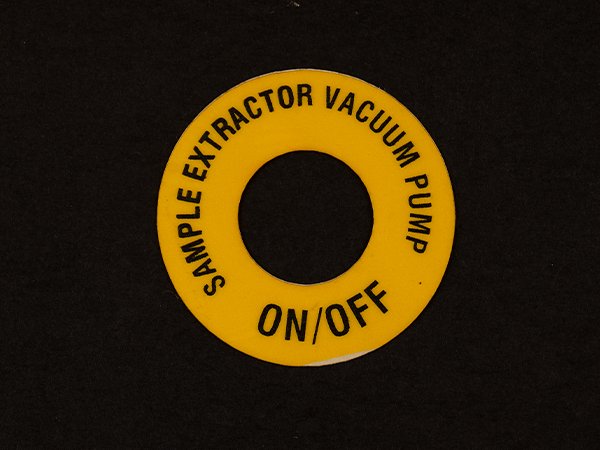 | Plastic Labels PVC & Polycarbonate Stickers are often used in various industries. View product → |
When should you repair or replace a monsoon-exposed label?
1. Inspect every label after the monsoon, starting with lifting corners, bubbling, whitening, fading, cracked coatings, trapped water, adhesive residue, illegible small text, corrosion around rivets or screws, and water paths along unsealed edges. Square corners, dirt, and loose paint accelerate failure; rounded corners and a sealed graphic edge improve monsoon-proof nameplates in Mumbai.
2. With brass nameplates, monsoon in Mumbai exposes tarnish beneath damaged lacquer, pitting, loose fasteners, and galvanic corrosion where dissimilar metals meet. Check polycarbonate for yellowing, print loss, laminate separation, and lost barcode or control-panel contrast. Appearance becomes a safety problem when small text or contrast no longer supports confident reading.
3. Replace the label when an equipment number, warning, rating, operating instruction, emergency marking, or regulatory identification cannot be read from the normal viewing distance. Do not wait for total film failure; a faded warning or unreadable barcode has already failed its purpose.
4. Rebond only when the substrate is sound and the replacement adhesive system is approved for that surface. Replace rather than patch labels with widespread edge lift, moisture beneath the graphic, cracked coating, or corrosion at mounting points.
5. Record the exposure location and failure mode. Use that record to change the finish, adhesive, corner radius, or mounting method on the next order of brass nameplates or polycarbonate labels for Mumbai conditions.
Frequently asked questions
Which material suits each Mumbai outdoor application?
Use brass nameplates for rigid, permanent identification on buildings, gates and fixed assets. Use polycarbonate stickers for curved equipment, control panels, vehicles, machinery and temporary labels.
What parts determine monsoon service life?
Service life depends on the material grade, print method, UV protection, adhesive, edge sealing, mounting surface and exposure to standing water, heat and abrasion.
How should you install labels before the rains?
Clean and degrease the surface, remove oxidation and loose paint, dry it completely, apply the label without trapping air, and seal exposed edges when the construction requires it.
What should you ask a Mumbai supplier before ordering?
Ask for the material thickness, outdoor temperature range, UV protection, adhesive type, print durability, edge-sealing method, fixing options and proof of testing for the intended surface.
When should you repair or replace a monsoon-exposed label?
Repair or replace the label when lettering becomes unreadable, the film blisters, edges lift, water enters beneath the face, brass corrodes around fixings or the plate no longer stays secure.