
The choice is not simply between metal and plastic: it determines when branding is added, how much tooling you fund, how easily artwork changes, and how the finished part survives use. By the end, you will be able to compare both routes against volume, geometry, environment, readability, replacement needs, and the full delivered cost.
Key takeaways
- Choose nameplates for flexible batches, field replacement and late-stage branding.
- Choose in-mold decoration for high volumes and branding built into molded parts.
- Specify substrate, adhesive, artwork, finish, tolerances and environmental exposure.
- Compare quotes by tooling, setup, inspection, replacement and line-integration costs.
How stainless steel nameplates and in-mold decoration are made
The actual difference is when the branding becomes part of the product. A stainless steel nameplate is made separately, marked or printed, and attached after the plastic housing or metal enclosure is finished.
In-mold decoration places a printed film or label inside the injection mold, so molding bonds or encapsulates the graphic into the plastic part.
| Option | How it is made | What the finished product contains |
|---|---|---|
| Stainless steel nameplate | Cut, etched, printed, laser-marked, or embossed steel is attached with adhesive, rivets, screws, or clips. | A separate metal component joined to the housing |
| In-mold labeling (IML) | A preprinted label is positioned in the mold before thermoplastic is injected around it. | A label fused into or covered by the molded plastic |
| In-mold decoration (IMD) | A printed, formed, or transfer-coated film is registered against the mold surface and bonded during molding. | An integrated graphic, and sometimes windows, buttons, or conductive features |
For stainless steel nameplates vs in mold decoration in Pune, the key production question is whether branding remains replaceable. A plate can be produced after molding, allowing serial numbers, artwork, and product variants to change without modifying the injection mold.
IMD or IML requires compatible film, ink, and thermoplastic, plus dedicated mold interfaces and accurate registration; changing the graphic can require new tooling or process trials.
A stainless plate sits on the surface. An in-mold graphic follows the molded geometry and is produced within the molding cycle. That difference affects later decisions about volume, replacement, durability, and cost.
Which process fits your product volume, geometry and production line?
Choose a separately applied stainless plate when variants, serial numbers, artwork or order quantities change frequently. Stainless steel nameplates for businesses in Pune can be etched, printed or laser marked independently of the injection mold, so a design revision does not automatically create tooling work.
Choose in-mold decoration when one thermoplastic housing runs repeatedly at moderate or high volume and the graphic must sit flush with the surface. In-mold decoration branding in Pune can eliminate a badge edge and integrate backlighting, capacitive buttons, transparent windows or conductive tracks into the fascia.
It requires compatible plastic, film coverage, registration control and mold trials; trapped air, silvering or film misalignment can ruin a large batch.
| Option | Best fit | Production and design consequence |
|---|---|---|
| Stainless plate | Low or changing volumes; flat or accessible surfaces; frequent artwork or identification changes | Add fabrication, adhesive or mechanical attachment and assembly time, but retain low-cost revisions and field replacement |
| In-mold decoration or labeling | Repeated medium-to-high volume; stable artwork; molded fascia with suitable geometry | Combines graphic application with molding, but adds film-forming or label-handling setup, registration checks and tooling amortisation |
| Integrated functional film | Backlighting, touch buttons, windows or conductive tracks | Delivers functions a conventional plate cannot provide without separate electronics |
Compare the same quantity, geometry, service life and change frequency. A low-volume IMD quote can look cheap per part while hiding mold modification, setup and trial costs; a stainless quote can hide application labor. Choose the route that matches the production line, not just the sample finish.
How do durability, readability and field replacement compare?
Field replacement is the clearest dividing line: a stainless steel nameplate can be removed and replaced without changing the housing, while in-mold decoration normally requires replacing the molded part. Treat metal nameplates vs molded branding as an assembly decision, not a steel-versus-plastic contest.
| Condition | Stainless steel nameplate | In-mold decoration |
|---|---|---|
| Abrasion and impact | Steel resists knocks, but exposed ink, clear coat, adhesive, or lifted edges can fail. | Protected film and resin resist edge lifting; deep scratches or damaged molding are permanent. |
| Chemicals and cleaning | Specify ink, coating, adhesive, and cleaner compatibility; solvents can attack the graphic or joint. | Film, ink, overlay, and resin must withstand the actual disinfectant, detergent, and wipe cycle. |
| UV and heat | Metal survives, but fading, adhesive ageing, and temperature cycling can reduce performance. | UV-stabilised film and compatible resin are essential; heat can distort film or fade ink. |
| Moisture | Condensation and contaminated surfaces can weaken adhesion, especially on polypropylene or textured plastic. | The integrated graphic avoids a bonded edge, but moisture can still expose resin or film weaknesses. |
| Operator viewing | Brushed metal can glare; specify contrast, font size, and tactile detail for the viewing angle. | A flush graphic supports clean, continuous surfaces and fine features, but contrast depends on film and molding registration. |
For either route, test the complete construction on the production substrate, including abrasion, chemical wipes, humidity, UV, temperature cycling, and impact. UL 969 can guide certified marking evaluation, but it does not approve unspecified steel, ink, adhesive, or molded graphics.
What technical details must you put into the specification?
A production specification must turn “looks right” into measurable release criteria. State the production substrate, geometry, artwork layers, attachment method, molding conditions, registration datum, environmental exposure, test methods, and acceptance tolerances.
| Detail | Stainless steel nameplate | In-mold decoration |
|---|---|---|
| Material | Grade, thickness, edge radius, flatness, finish, coating | Film resin, thickness, surface finish, compatible molding thermoplastic |
| Artwork | Vector file, Pantone or RAL references, print or etch layers, protective overlay | Film artwork, forming compensation, print layers, approved 3D distortion limits |
| Attachment and molding | Adhesive type, bond area, surface cleaning, application pressure and cure time | Mold cavity, insert or registration features, draft, radii, draw depth, injection temperature and pressure |
| Registration | Datum, hole or stud coordinates, logo-to-edge tolerance | Film datum, molded-feature coordinates, allowable shift and distortion |
| Testing | Adhesion on the actual housing, abrasion, chemicals, humidity, UV and temperature cycles | Film-to-part adhesion, abrasion, chemicals, humidity, UV, temperature and impact |
| Inspection | Dimensions, print legibility, color, scratches, bubbles and edge lift | Part dimensions, logo position, wrinkles, bridging, sink marks, voids and incomplete bonding |
Specify the actual plastic and finish: polypropylene, polyethylene, textured resin, powder coating and release-agent residue can invalidate adhesive results from a smooth test panel. For certified electrical products, identify whether UL 969 evaluation applies to the complete marking construction, not merely the plate.
- Name ISO 9227 or ASTM B117 for salt-fog work and ISO 4892-3 for fluorescent UV exposure.
- Approve a formed-film or molded trial against a signed drawing before production release.
- Record batch traceability, sample quantity, inspection equipment and rejection limits.
How should a Pune buyer compare quotes and suppliers?
Compare quotes only after giving every supplier the same quantity, 3D geometry, service life, cleaning chemicals, temperature and humidity cycle, artwork-change frequency, and inspection standard. A low unit price can hide injection-mold tooling, film setup, post-processing, adhesive application, or assembly labour.
| Route | Total-cost items | Change and lead-time risks |
|---|---|---|
| Stainless steel nameplate | Plate, print or etch, coating, adhesive or studs, application labour, packing, and replacement stock | Artwork and serial-number changes are easier; ask for sample and production lead times separately |
| IMD or IML | Film, forming, printing, tooling or mold insert, setup, trials, scrap, and mold changeover | Freeze film geometry and registration early; ask for tooling amortisation at your stated quantity |
| Both | Freight, inspection, rejected parts, traceability records, and service support | Require a written validity period and revision-control process |
For custom product branding in Pune, demand a formed-film or molded trial against the actual enclosure. A flat artwork proof cannot reveal stretching, wrinkling, bridging, incomplete adhesion, or logo misregistration on deep draws and sharp radii.
Ask each supplier for:
- Two samples: an approved cosmetic sample and a production-representative sample with the proposed attachment or mold process.
- Tooling ownership, modification charges, amortisation volume, and the cost of an artwork revision.
- A dated schedule covering design review, trial, first article, approved production, and replacement parts.
- Batch, material, ink or film, and inspection records tied to a purchase order or serial range.
- Pune pickup or delivery coverage, escalation contact, response time, and support for field replacements.
Shreeniwas Signs Pvt Ltd can be included in the comparison when its quotation states these inputs rather than presenting a unit price alone.
Related products
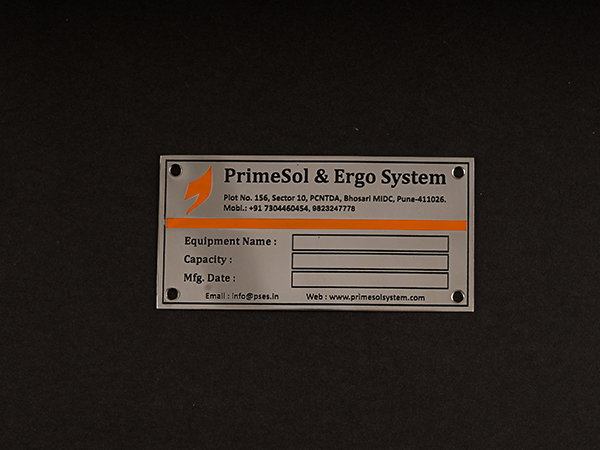 | Metal Labels In the most testing conditions, particularly overwhelming modern situations, where heat, moisture and erosion are available, Stainless Steel... View product → |
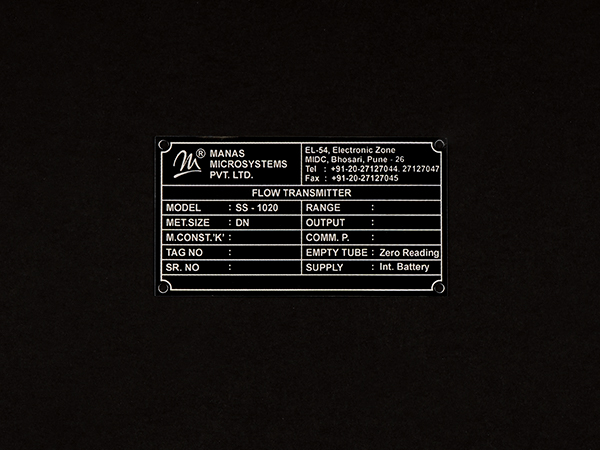 | Metal Labels Machine Specification Nameplate A Machine Specification Nameplate distinguishes and shows an item's name on gadget. View product → |
Frequently asked questions
How do stainless steel nameplates differ from in-mold decoration?
A stainless steel nameplate is produced separately, marked or printed, then attached to a finished enclosure. In-mold decoration places the printed film inside the mold so branding becomes part of the molded plastic surface.
Which option suits different product volumes and geometries?
Stainless steel nameplates suit variable volumes, product variants and designs that need late-stage application. In-mold decoration suits stable designs, high production volumes and plastic parts whose geometry supports accurate film placement and molding.
Which branding method is easier to replace in the field?
A separately attached stainless steel nameplate can be replaced on a finished product when the substrate and adhesive allow removal. In-mold decoration is integrated into the molded part, so damaged branding usually requires replacement of the complete part.
What should a Pune buyer include when comparing supplier quotes?
Request separate prices for tooling, artwork setup, samples, production quantities, inspection, packaging and replacement parts. Compare material grade, marking method, adhesive, finish, tolerances, environmental exposure and production-line application requirements.
Related products
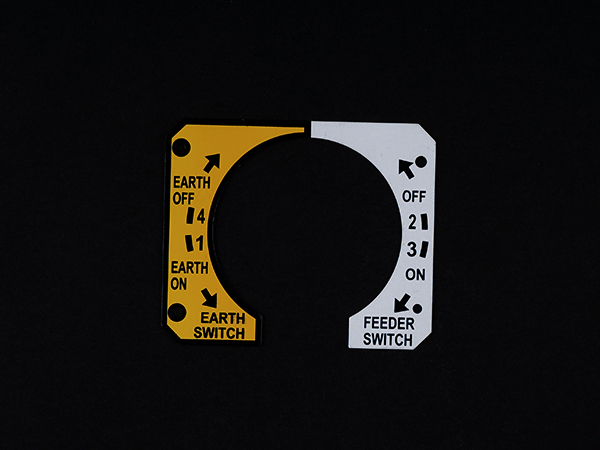 | Metal Labels A Control Panel Nameplate a flat, regularly vertical, region mounted on machine where control or observing instruments information are shown They are... View product → |
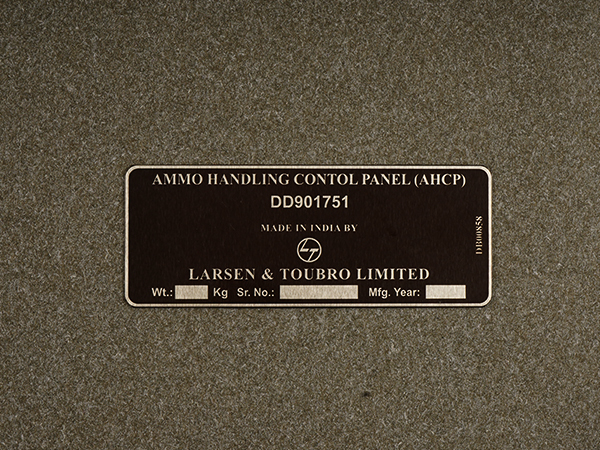 | Metal Labels Metalphoto Metalphoto is a specific kind of photosensitive anodized aluminum that is used to make durable, high-resolution nameplates, labels and control... |