


A rigid plate and a flexible overlay solve different control-panel problems: one prioritises mechanical stability and straightforward replacement, while the other integrates legends, windows, keys and tactile features into a thin interface. By the end, you will be able to select the construction, define measurable specifications, check sealing and safety implications, and prepare an accurate replacement drawing.
Key takeaways
- Choose rigid nameplates for stable flat panels and overlays for integrated controls.
- Match the face material to chemicals, abrasion, heat, moisture and sunlight.
- Record panel dimensions, cut-outs, hole centres and clearances before ordering.
- Specify sealing, safety markings and tactile feedback alongside artwork and materials.
When should you use a rigid nameplate instead of a graphic overlay?
Choose a rigid nameplate when the panel is flat, thick and mechanically stable; choose an overlay when the interface itself is thin and carries controls or printed functions. The wrong choice creates clearance problems, trapped dirt or an expensive replacement.
| Construction | Mounting and feedback | Best fit |
|---|---|---|
| Rigid aluminium, stainless-steel or Metalphoto plate | Mechanically retained with exposed fasteners; firm, non-flexing surface and separate labels | Rigid flat panels with independent switches and legends |
| Adhesive-backed graphic overlay | Bonds across the face; printed legends, display windows, membrane keys or embossed domes provide the operator feedback | Thin interfaces with stable, integrated functions |
A rigid plate tolerates repeated pressing around controls without flexing and is easier to clean around its edges. It also removes without disturbing switches, wiring or a control bezel.
An overlay gives a cleaner one-piece face, but its edges, cut-outs and substrate must be designed to seal a continuous surface; an overlay alone is not an enclosure seal.
Check selector-switch clearance before approving graphic overlays for control panels. An overlay can foul a switch bezel, reduce rotation clearance or interfere with an emergency-stop actuator, especially where domes or thick adhesive raise the surface.
Use separate labels when controls are replaced frequently, recipes change, repairs are routine or the panel will be reconfigured. Use a printed overlay for stable control layouts, one-piece legends and integrated membrane functions. That distinction guides control panel nameplates or graphic overlays for harsh factories.
Which face material survives your factory’s actual exposure?
Choose polyester for control panel nameplates or graphic overlays for harsh factories when abrasion, oils, solvents and repeated chemical wiping dominate. Choose polycarbonate when impact, vandalism or forming around contours matters more. Neither choice is valid until you name the cleaner, oil, solvent, temperature range and expected abuse.
| Material | Strengths | Limits and checks |
|---|---|---|
| Polyester | Strong abrasion and chemical-wiping resistance; good for repeated operator contact | Confirm compatibility with coolant, solvents, humidity, UV and heat |
| Polycarbonate | Higher impact resistance; easier forming around curves and controls | Check scratching, chemical attack, UV and heat exposure |
| Aluminium or stainless steel | Rigid plate; finish, marking method and edge treatment determine durability | Poor edge treatment or weak marking can fail under impact, moisture and cleaning |
| Metalphoto | High-resolution anodized-aluminium construction | Durability depends on the complete part, including sealing, edges and mounting |
| PVC or vinyl | Suitable for lighter-duty labels where limits are controlled | Do not treat “industrial” as a performance rating; verify heat, UV, chemicals and cleaning |
Require testing of the printed construction on the actual powder-coated steel, painted metal, stainless steel or plastic panel. Reverse printing places ink behind a transparent face, protecting it from direct abrasion, but the film, hard coat, adhesive, cut edge or mounting surface can still fail.
For control panel labels for factories in Pune, test humidity, coolant, oil mist and cleaning practice at the installation.
What belongs in a control panel nameplate specification?
A usable control panel nameplate specification names the complete construction, not just the artwork and overall size.
1. Put these fields on the drawing and purchase order: face material and thickness; finish or gloss level; ink system and print side; adhesive family; intended substrate; mounting-surface preparation; minimum application temperature; service-temperature range; named chemicals and exposure method; dimensional tolerance; print-registration tolerance; cut-outs; corner radius; backing-liner type, split and release direction; and durability-test criteria.
2. Define the visual requirements: minimum text height; colour references such as RAL, Pantone or a measured CIE value; viewing distance and lighting; minimum text-to-background contrast; and the position of every symbol and legend relative to its switch, lamp, display or selector.
State the cut-out clearance and keep-clear zone, or a bezel can obscure text and an overlay can foul a control.
3. Require the adhesive specification to cover low-surface-energy plastics, textured powder coat, condensation, thermal cycling, application pressure and edge-lift inspection. A nominal peel-strength figure is not enough: thin adhesive may fail to wet a rough surface, while thicker adhesive may cold-flow or collect dirt.
Specify abrasion, chemical wiping, humidity, temperature-cycle and post-test legibility pass criteria on the actual construction. UL 969 evaluates a specific marking-system construction; it is not blanket approval of every nameplate or overlay.
How do you measure an existing control panel before ordering a replacement?
Start from two fixed datum edges, not from a photograph. This sequence turns control panel nameplate specifications into a drawing that a fabricator can check.
1. Record overall width, height, material thickness, flatness and every corner radius. Measure each mounting-screw centre horizontally and vertically from the same two datum edges.
2. Measure every switch, lamp, display and selector cut-out by diameter, width or height. Record each centre coordinate, bezel size, selector rotation clearance and the keep-clear zone around the control.
3. Plot every legend relative to its control centre. Mark gasket lands, enclosure joints, cable entries, membrane tails, bends, seams and any area the overlay must not bridge.
4. Photograph surface defects only as supporting evidence. Record coating type, texture, contamination, scratches and exposed metal; note whether cleaning or surface preparation is needed. These details matter for industrial control interfaces in Pune as much as the city’s climate.
5. Supply a 1:1 CAD file or dimensioned tracing. State dimensional, corner-radius, cut-out and print-registration tolerances on the drawing, not inside artwork software. Approve a physical proof when controls sit close together, because a small registration error can obstruct a bezel, legend or actuator.
How should an overlay handle sealing, safety functions and operator feedback?
Treat a decorative legend as printed identification, not as a seal. An interface seal requires controlled edges and cut-outs, but the overlay alone has no IP rating. Under IEC 60529, protection belongs to the complete enclosure assembly: bezels, gaskets, fasteners, cable entries, display windows and installation.
For washdown areas, name the detergent concentration, sanitizer, cutting fluid, hydraulic oil or solvent, temperature, dwell time and wiping cycles. Then test the complete printed construction, including face film, ink, adhesive, substrate and edges; “chemical resistant” without a liquid and exposure time cannot be compared.
For industrial control interfaces in Pune, specify each tactile feature rather than only its legend. Record dome type, emboss height, actuation force, travel, alignment tolerance and cycle life. Glove-friendly feedback improves operation without visual attention, but embossing reduces flat print area and creates dirt traps.
- Keep emergency stops spaced for immediate access; preserve selector rotation, indicator visibility and unimpeded actuator movement.
- Apply IEC 60204-1 to machine electrical equipment and ISO 13850 to emergency-stop design.
- Use red, yellow and standardised symbols consistently, but never let printed colour replace the actuator, safety circuit, accessibility or reset design.
- Check bilingual legends at full size; shrinking text or translating only selected safety functions creates ambiguity.
How do you buy and qualify the right construction in Pune?
For control panel nameplates or graphic overlays for harsh factories, buy against the installation, not the city.
For control panel labels for factories in Pune, record indoor or outdoor location, ambient temperature, humidity and condensation, UV exposure, coolant or oil mist, cleaning practice, glove use, languages and expected reconfiguration frequency.
| Option | Best fit | Decision signal |
|---|---|---|
| Separate labels | Frequently replaced switches or revised layouts | Choose for repair access and changing legends |
| Complete overlay | Stable interface with integrated appearance or membrane function | Choose when one-piece appearance or membrane feedback matters |
| Custom rigid plate or direct-applied label | Independent identification on a rigid panel | Compare mounting, substrate and removal effort |
Industrial control interfaces in Pune deserve the same evidence: request a sample made with the final face film, ink, adhesive and substrate. Specify abrasion, repeated chemical wiping, humidity or condensation, thermal cycling and UV exposure where relevant; inspect adhesion and edge lift, then require post-test legibility for text, symbols and colour contrast.
Evaluate Shreeniwas Signs Pvt Ltd on these measured inputs, not on material names alone.
Related products
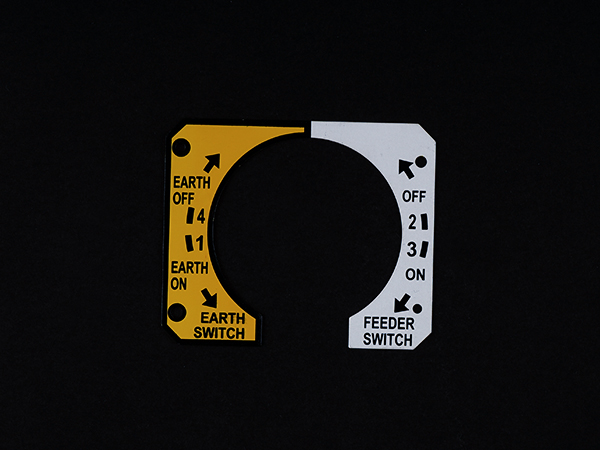 | Metal Labels A Control Panel Nameplate a flat, regularly vertical, region mounted on machine where control or observing instruments information are shown They are... View product → |
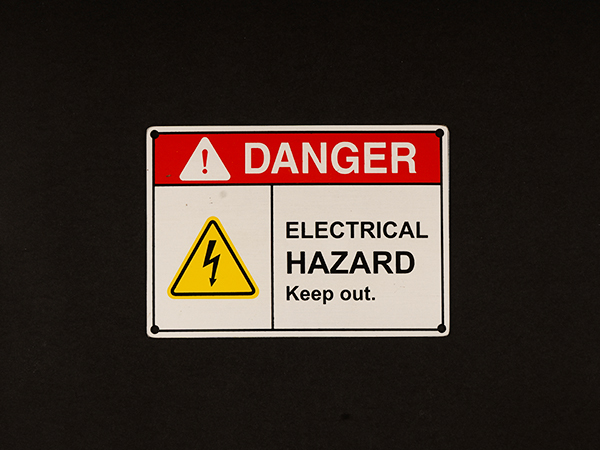 | Metal Labels Aluminum Nameplates are popularly known for their light weight and capacity to oppose corrosion.Its recognizable gleaming white shine offers... View product → |
Frequently asked questions
When should you use a rigid nameplate instead of a graphic overlay?
Use a rigid nameplate for a flat, thick and mechanically stable panel. Use a graphic overlay when the interface is thin and carries printed functions, controls or feedback.
Which face material survives a harsh factory environment?
Choose the face material after identifying the actual exposure: chemicals, abrasion, heat, moisture, ultraviolet light and cleaning agents. Compare material resistance against those conditions rather than choosing by appearance alone.
What belongs in a control panel nameplate specification?
Include dimensions, thickness, material, finish, adhesive, printing method, colours, symbols, text, tolerances, cut-outs, mounting details and the operating exposure.
How do you measure an existing control panel before ordering a replacement?
Record the overall face size, corner radii, cut-outs, hole centres, edge clearances, mounting points and nearby obstructions. Photograph the panel with a ruler and verify measurements against the original drawing.
How should an overlay handle sealing, safety functions and operator feedback?
Define the seal around switches and openings, preserve required safety markings, and specify the tactile or visual feedback operators need. Do not let decorative artwork cover emergency-stop identification or other safety information.
Related products
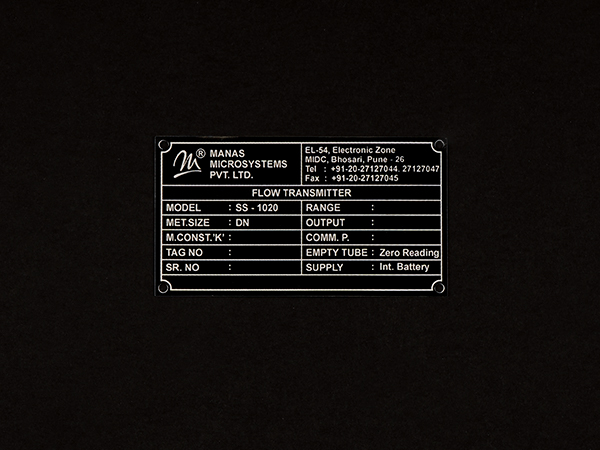 | Metal Labels Machine Specification Nameplate A Machine Specification Nameplate distinguishes and shows an item's name on gadget. View product → |
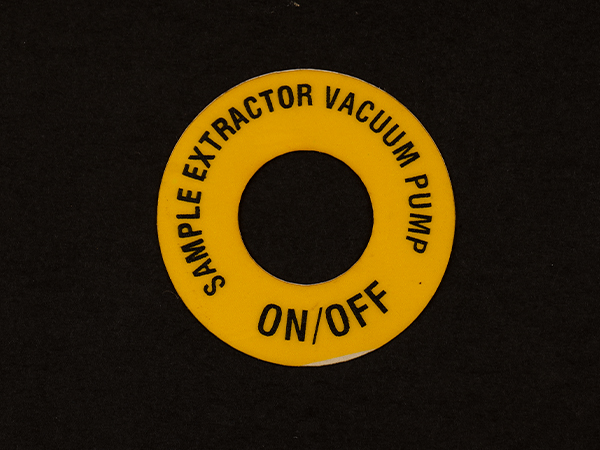 | Plastic Labels PVC & Polycarbonate Stickers are often used in various industries. View product → |
 | Metal Labels In the most testing conditions, particularly overwhelming modern situations, where heat, moisture and erosion are available, Stainless Steel... View product → |
 | Plastic Labels Vinyl Decals & Sticker is a kind of plastic that originates from characteristic substances, for example, salt and is viewed as an earth-accommodating... View product → |