

A storefront plaque in Bengaluru must handle monsoon water, humidity, dust, pollution, sunlight, cleaning and daily contact without becoming difficult to read or maintain. By the end, you will be able to choose the steel grade, finish, lettering, dimensions, fixings and drainage details for a sign that suits your façade and budget.
Key takeaways
- Choose 316 stainless steel near coastal air or chemical exposure.
- Use high-contrast etched or engraved lettering for pavement-distance readability.
- Specify edge treatment, drain paths, fixings and sealant before fabrication.
- Add a stand-off, backplate or illumination when the façade demands it.
Is stainless steel suitable for an exposed Bengaluru storefront?
Stainless steel suits an exposed shop, office or commercial façade, not only an industrial site. Monsoon rain, humidity, airborne dust, traffic pollution and repeated washing usually affect the surface rather than the plate’s structural strength; strong sunlight can fade applied graphics or coatings before it harms the steel.
Design out ledges, lettering returns and spacer cavities that retain water and dirt.
Tea staining is brown surface discoloration caused by moisture, airborne iron or salt, rough texture and inadequate cleaning. It is surface corrosion, not automatic evidence that the entire plate has failed.
| Grade | Best use | Limitation |
|---|---|---|
| 304 | Baseline for a sheltered urban façade and most weather resistant business nameplates | Less tolerant of chloride contamination and persistent damp crevices |
| 316 | Saline air, chloride contamination, chemical fumes, irrigation spray or damp crevices | Cannot rescue poor drainage, contaminated fabrication or bad installation |
| 430 | Lower-cost magnetic grade where shelter and cost control dominate | Weaker atmospheric and crevice-corrosion resistance; risky for exposed signs |
Specify periodic washing with clean water and mild detergent. Avoid chlorine cleaners, hydrochloric acid and steel wool, which can damage or contaminate the finish. For stainless steel nameplates for outdoor storefronts in Bengaluru, inspect after monsoon periods and remove traffic film before it holds moisture against the face.
Which finish and lettering will stay readable from the pavement?
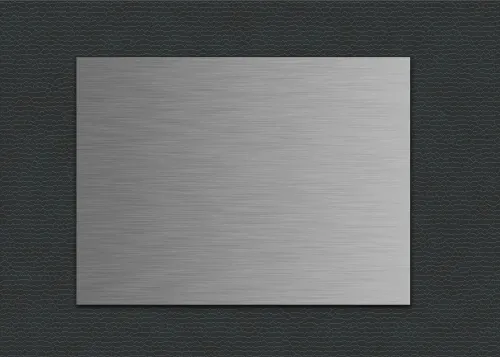
Directional brushed or satin stainless usually gives the most dependable pavement-level readability for storefront metal signs in Bengaluru. It hides fingerprints, fine scratches and water marks better than mirror polish, but inconsistent grain becomes obvious on a flat face under grazing light.
| Option | Visible result | Repair or replacement implication |
|---|---|---|
| Directional brushed or satin | Low glare and practical everyday appearance | Re-brushing can leave a visible directional mismatch |
| Mirror polish | Bright, reflective face with strong glare risk | Shows fingerprints, scratches and water marks; polishing repairs rarely blend perfectly |
| Painted or powder-coated | Strong colour contrast and useful branding | Specify UV resistance, coating system and edge sealing; repainting or recoating is a separate job |
| Etched and filled graphics | Permanent recessed marks with contrasting fill | Fill can be renewed without replacing the steel; etching remains if the fill fails |
| Engraving | Cut marks without relying on surface ink | Durable, but changing names or logos usually requires a new face |
| Screen printing | Sharp economical graphic on the surface | Ink can fade or peel; specify UV-rated ink and a replacement process |
| Raised metal letters | Shadow and depth improve recognition | Individual characters can be replaced |
| Cut-through lettering | Openings reveal a backplate, light or background | Damage usually affects the panel, not just the letter |
| Separately fixed characters | Replaceable individual letters or logos | Loose fixings and alignment require inspection |
Glare can erase contrast in direct sun, while shade needs brighter lettering or a contrasting backplate. After dark, provide illumination or choose reflective contrast; approve the result from the pavement, not only from a close-up proof.
- Measure viewing distance and set letter height accordingly.
- Use strong contrast and sufficient stroke weight.
- Simplify fine logo details.
- Approve grain direction and character orientation from the intended viewing angle.
- Specify UV resistance, ink or coating system, and edge sealing separately; applied graphics can fail before the stainless substrate.
How do size, thickness and mounting details prevent a failing plaque?
Use 1.2–2.0 mm stainless sheet for a typical flat plaque, but choose thicker metal, a folded return edge, frame or backplate when the sign is large, freestanding or frequently handled. Thin unsupported sheet can oil-can, bow around fixings and develop sharp or lifting edges under wind movement.
Mounting choice determines security as much as thickness:
| Option | Advantage | Risk or use |
|---|---|---|
| Concealed studs | Clean face and good theft resistance | Needs accurate drilling and sound substrate |
| Tamper-resistant screws | Serviceable and difficult to remove | Exposed heads require washers and neat alignment |
| Restrained backplate | Distributes loads and controls distortion | Needs clearance and drainage |
| Stand-off spacers | Reduces damp contact and adds shadow | Detail cavities so water cannot sit |
| Adhesive-only tape | No visible holes | Fails with dusty, uneven, wet or poorly painted walls |
Tape depends on sound paint, low dust, wall flatness, temperature, water control and the tape manufacturer’s surface-preparation and application conditions. It is a poor sole fixing for permanent outdoor stainless steel nameplates in bengaluru.
Match the fixing to the façade:
- Glass: use bonded pads or clamps designed for glass; do not drill without specialist approval.
- ACP: fix into approved rails or a mechanically restrained backplate, not only the thin skin.
- Painted plaster: use studs or anchors after confirming the plaster is sound.
- Concrete and stone: use suitable anchors; avoid cracking edges and weak mortar joints.
- Rolling shutters: use a lightweight restrained frame that tolerates movement.
Isolate stainless from aluminium, galvanized steel and carbon steel with nonconductive washers, sleeves, gaskets or barrier coatings. Leave an open or sloped lower edge, drained cavity and wall clearance so rainwater cannot remain behind the plaque.
What should you put in the fabrication and installation specification?
For weather resistant business nameplates, write measurable requirements instead of “weather resistant.” For storefront metal signs in bengaluru, attach a drawing and require approval before fabrication.
1. State stainless grade: 304 for a sheltered urban façade or 316 for chloride, chemical-fume, irrigation-spray or persistent-damp exposure.
2. Specify sheet thickness, folded returns or a frame, surface finish, and directional grain; approve grain direction from the intended viewing angle.
3. Define edge treatment: deburred, radiused or folded edges, with no sharp corners or lifting lips.
4. Identify the lettering method—etched-and-filled, printed, cut-through, raised letters or separately fixed characters—and specify UV resistance, ink or coating system, edge sealing and replacement method.
5. Show the fixing pattern, hole locations, returns and studs on drawings before drilling or re-brushing. Include the intended viewing angle.
6. Name spacer material and require nonconductive washers, sleeves or gaskets against aluminium, galvanized steel or carbon steel.
7. Specify a compatible exterior sealant, an open or sloped lower edge, drained cavities and wall clearance; neither ASTM A967/A967M chemical passivation nor ASTM B912 electropolishing replaces drainage or dissimilar-metal isolation.
8. Require removal of weld heat tint and embedded iron particles, followed by appropriate pickling/passivation or equivalent post-fabrication cleaning.
9. State washing with clean water and mild detergent, inspection intervals and prohibited cleaners: chlorine, hydrochloric acid and steel wool.
10. Inspect for sharp edges, inconsistent grain, water traps, staining around holes and secure restraint.
Shreeniwas Signs Pvt Ltd can help convert the façade, artwork, substrate and fixing method into this documented specification rather than quoting only a steel plate.
Related product
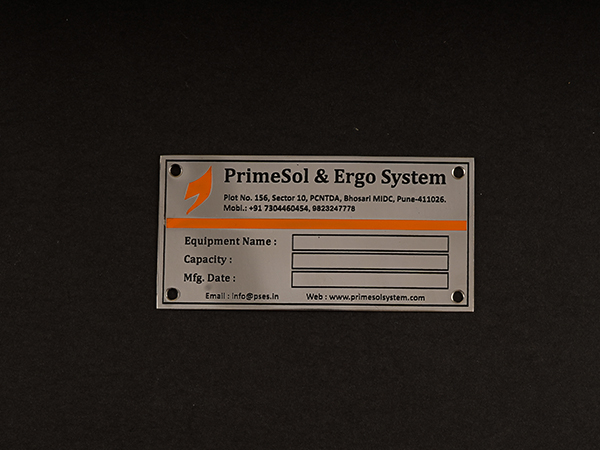 | Metal Labels In the most testing conditions, particularly overwhelming modern situations, where heat, moisture and erosion are available, Stainless Steel... View product → |
When does the sign need a backplate, frame, stand-off or illumination?
A simple plaque is enough when the frontage is bright, flat and visible from the pavement. On dark stone, a shaded recess or ACP cladding, choose painted contrast, raised characters or a contrasting backplate instead of relying on a brushed face.
Use a backplate or folded frame when the panel is large, thin, spans uneven masonry, needs concealed wiring or requires stronger restraint. The return edge adds rigidity and hides fixings; it also reduces bowing and lifting at the corners.
Stand-off mounting creates shadow, separates lettering from a busy wall and keeps stainless away from damp contact. Specify solid spacers or sleeves, wall clearance, and an open or sloped lower edge so rainwater drains rather than sitting inside spacer cavities. A sealed perimeter that traps moisture is a failure, not weatherproofing.
For outdoor stainless steel nameplates in Bengaluru, illumination after dark can come from backlit raised letters, edge lighting or a separately lit plaque. Provide a drain path, protected cables and an accessible route for LED or driver replacement.
- Confirm daylight readability from the intended approach and night-time recognition at the actual viewing distance.
- Specify UV-resistant ink or coating, edge sealing and a replacement method separately from the steel; graphics can fail before the panel.
- Wash the face periodically with clean water and mild detergent; inspect fixings, sealants and drainage after monsoon exposure.
- Replace etched fills, printed graphics or raised characters without replacing a sound panel, and record the method for future service on stainless steel nameplates for outdoor storefronts in Bengaluru.
Frequently asked questions
Is stainless steel suitable for an exposed Bengaluru storefront?
Yes. Stainless steel handles monsoon rain, humidity, dust, pollution and repeated washing well when you select a suitable grade, finish and fixing system. Sunlight threatens applied graphics and coatings before it threatens the steel itself.
Which finish and lettering will stay readable from the pavement?
Choose a finish that controls glare and pair it with strong contrast. Brushed or satin stainless steel is easier to read than a mirror finish, while etched, engraved or durable printed lettering suits different budgets and visibility requirements.
How do size, thickness and mounting details prevent a failing plaque?
Size the plaque for the viewing distance, use enough thickness to resist flexing, round or deburr exposed edges, and specify fixings that suit the wall. Seal penetrations without trapping water behind the plate.
What should a stainless steel nameplate fabrication specification include?
State the stainless steel grade, sheet thickness, dimensions, finish, lettering method, colour, artwork, corner radius, hole positions, fixing type, installation surface, sealant and inspection requirements.
When does a storefront sign need a backplate, frame, stand-off or illumination?
Use a backplate or frame when the wall is uneven or the plaque needs visual separation. Choose stand-offs when shadow and depth improve legibility. Add illumination when the storefront must remain readable after dark or sits in a poorly lit entrance.