


A brass plate can restore a missing legend, but it cannot correct an outdated circuit designation, a damaged panel face, or a label that must meet a safety-sign standard. By checking the panel, documenting its controls and drawings, and comparing brass with more suitable materials, you can decide whether replacement will improve operation or create another control panel nameplate problem.
Key takeaways
- Replace labels when legends are incomplete, misleading, or lifting.
- Photograph the panel and record every legend before removal.
- Choose brass only when its exposure and readability benefits fit the panel.
- Record revision, material, adhesive, and installation date for traceability.
When replacing a faded control panel label is justified
Cleaning is enough only when the legend remains complete, legible and securely bonded after removing dirt or oil. Replace faded control panel labels when the marking has disappeared, operators can misread a function, or the label substrate, adhesive or laminate is lifting.
A physical replacement is justified if any of these conditions applies:
- The text, arrow direction, warning symbol, voltage or circuit identifier cannot be read at the normal operating distance.
- A faded legend identifies an emergency function, disconnect, motor circuit or other control whose misreading could cause a wrong operation.
- The old label is cracked, peeling, swollen, stained through, or surrounded by adhesive residue and ghosting that cleaning cannot remove.
- The panel has been modified, leaving the existing legend inconsistent with the electrical drawing, I/O schedule, PLC arrangement or motor-control layout.
- The panel surface is warped, textured, curved, recessed or contaminated, so a cosmetic touch-up will not provide a stable marking.
Do not choose brass merely because it hides the old mark. Confirm the replacement text against the panel drawings, and record the existing layout before removal. Check that the plate will not cover safety information, indicators, fasteners or operating clearances.
Bare brass conducts electricity, so it must not reduce required creepage, clearance, bonding or enclosure protection. Also assess humidity, chlorides, acidic or ammonia cleaners and sulfur-bearing air: engraving can remain intact while brass tarnishes or stains. These checks distinguish a lasting correction from another set of control panel nameplate problems.
Document the panel before you remove anything
A photograph alone cannot reconstruct a safe control panel label. Record the panel’s identity, layout and electrical references before cleaning, peeling or unscrewing anything.
1. Photograph the full panel square-on, then take close, high-resolution images of every legend, warning symbol, selector position, pushbutton, indicator and circuit designation. Include a scale and panel reference number so each image has a location.
2. Transcribe the visible wording exactly, including arrows, uppercase letters, abbreviations, voltage values, terminal numbers and contact designations. Mark text that is missing, reversed, ambiguous or contradicted by another marking.
3. Confirm each function against the latest electrical schematic, panel drawing, terminal plan and PLC or I/O schedule. Do not copy a faded photograph when the machine has gained a new motor starter, changed PLC arrangement or altered circuit identification.
4. Record the original marking hierarchy: which text names the control, which line gives its circuit, and which symbol communicates danger, emergency shutdown or isolation. A replacement that omits a warning or changes its position can create a dangerous misread.
5. Measure the existing label, usable flat area, corner radius, hole centres, recess depth and clearances around switches, lamps, fasteners and inspection openings. Note curved covers, warped doors, textured powder coating, oil contamination and any edge that could lift an adhesive plate.
6. Identify whether the old marking is engraved, screen-printed, laminated or adhesive-backed, and record nearby energized terminals. Bare brass conducts electricity, so document clearances and bonding before specifying a plate.
These records expose control panel nameplate problems before removal and give the fabricator a proof that preserves the panel’s actual circuit design.
Match the brass plate to the panel and the viewing task
A plate that fits the old label’s length can still fail if it covers a switch legend, loses screw clearance, or bridges an energized terminal. Measure the usable flat area, corner radius, recess depth, hole centres, panel curvature, and distance between the plate, controls, indicators, and cut-outs.
Specify the viewing task before choosing lettering. At the operator’s normal standing distance, use enough character height and line spacing to distinguish adjacent functions; cramped text becomes unreadable under glare. Verify every legend against the electrical drawing and I/O schedule, not a faded photograph.
| Detail | Specify | Failure if ignored |
|---|---|---|
| Plate size | Length, width, thickness, corner radius, and edge clearance | Covers controls or leaves weak bonding area |
| Finish | Brushed, satin, polished, lacquered, or clear-coated brass | Glare, tarnish, or staining obscures contrast |
| Lettering | Engraved or printed text, character height, line spacing, symbols, and colour | Fine legends disappear at the viewing distance |
| Mounting | Adhesive grade, screw diameter, hole locations, countersinks, and surface preparation | Plate lifts from powder coat or interferes with wiring |
For brass nameplates for faded control panel labels, check humidity, oil, chlorides, cleaners, ammonia, and sulfur exposure before selecting a clear coat. Brass nameplates control panel labels must not reduce creepage, clearance, bonding, or enclosure protection; keep them away from live terminals and verify any panel certification impact.
Safety warnings also need the required contrast, colours, symbols, and signal words under ANSI Z535 or ISO 3864—not decorative brass alone.
Compare brass with materials built for the exposure
Engraved or printed brass earns its place when appearance, machinability, or permanent lettering matters more than low weight and maximum chemical resistance. Brass nameplates for control panel labels suit dry indoor panels, heritage equipment, premium machinery, and applications where a machined engraved legend must survive handling.
Bare brass still tarnishes under humidity, fingerprints, chlorides, acidic cleaners, ammonia, or sulfur-bearing air.
| Material | Main advantage | Choose it when |
|---|---|---|
| Brass | Engraved permanence and distinctive appearance | The panel is dry, the finish supports identification, and tarnish is acceptable or protected by a compatible clear coat |
| Anodized aluminium | Low weight, corrosion resistance, low glare | You need durable marking without adding much weight |
| Stainless steel | Strong resistance to impact, moisture, and cleaning chemicals | The panel faces washdown, outdoor weather, abrasion, or corrosive exposure |
| Metalphoto | Sealed photographic-quality graphics | You need fine multicolour legends, warning symbols, or high-resolution detail |
| Polycarbonate | Flexible, electrically insulating overlay | The surface is curved, textured, or close to energized hardware |
| Vinyl | Fast, low-cost adhesive identification | The label is temporary, replaceable, or exposed to mild indoor conditions |
Printed brass offers colour and fine graphics, but its coating becomes the wear point; engraving removes that dependency. Brass is conductive, so never use it as insulation or allow it to reduce creepage, clearance, bonding, or enclosure protection.
Choose the substrate after identifying the exposure, surface shape, cleaning chemicals, viewing distance, and attachment area. This comparison prevents control panel nameplate problems such as glare, lifting edges, chemical staining, or a replacement that fits the dimensions but fails in service.
Install, test and specify the replacement without losing traceability
Do not pry off the old label until you identify its construction. Engraved metal, screen-printed film, laminated stock and adhesive-backed vinyl leave different risks: paint may lift, adhesive may smear, and ghosting may remain. Photograph the panel before removal, then use a non-marring method suited to the label and finish.
Do not use heat or solvent near switches, seals or energized terminals.
Choose attachment from the site survey, not from plate size alone:
- Use industrial adhesive only on a clean, dry, sufficiently flat bonding area.
- Specify screws or rivets when vibration, oil, textured powder coating or a recessed pocket could defeat adhesive.
- Check hole locations, screw-head clearance, edge radii, curved covers and the spacing around controls.
- Keep bare brass away from terminals and preserve required creepage, clearance, bonding and enclosure protection.
- Record the panel drawing number, I/O schedule revision, plate text, warning symbols, arrows and circuit identifiers.
Ask for a proof against the drawing and I/O schedule before production. The quotation should state plate dimensions, thickness, corner radius, lettering method and size, finish or clear coat, attachment hardware, quantity, revision, and delivery basis. Also describe humidity, chlorides, acidic or ammonia cleaners, fingerprints and sulfur exposure; tarnish can obscure a readable engraving.
After installation, check every legend from the operator’s viewing distance, operate each control against the drawing, and inspect adhesion, screw security and clearance. A supplier such as Shreeniwas Signs Pvt Ltd can use these records to quote brass nameplates for faded control panel labels without losing revision traceability.
Related product
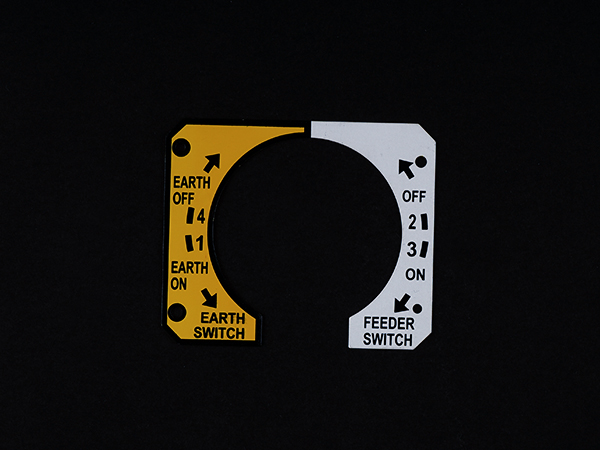 | Metal Labels A Control Panel Nameplate a flat, regularly vertical, region mounted on machine where control or observing instruments information are shown They are... View product → |
Frequently asked questions
When should you replace a faded control panel label?
Replace it when the legend has disappeared, operators could misread a function, or the substrate, adhesive, or laminate is lifting.
What should you document before removing a control panel label?
Photograph the complete panel, record each legend and position, and capture panel identification, revision, and wiring references.
Are brass nameplates suitable for every control panel?
No. Compare brass with materials designed for the panel’s heat, chemicals, sunlight, abrasion, cleaning methods, and viewing distance.
How do you preserve traceability after replacing a control panel label?
Record the replacement’s text, material, adhesive, revision, installation date, and location, then test legibility and operator interpretation.