

Brass is not automatically the better premium choice, and stainless steel is not one uniform material. Your decision depends on exposure to rain, chlorides, cleaners, abrasion and heat, as well as the marking method, mounting system and appearance you need to preserve. By comparing those conditions and specifying the plate precisely, you can choose the material that remains readable and serviceable on your equipment.
Key takeaways
- Choose brass for dry, sheltered equipment where appearance matters.
- Choose stainless steel for moisture, cleaning, abrasion or chemical contact.
- Compare alloy, grade, thickness and finish—not just the quoted price.
- Specify marking depth, contrast, adhesive and exposure conditions in writing.
Choose the material by equipment location and exposure
Start with exposure, not appearance: choose brass for dry, sheltered equipment where visual warmth matters, and stainless steel for moisture, cleaning, abrasion or chemical contact.
| Application | Better choice | Reason |
|---|---|---|
| Indoor machinery | Brass or 304 stainless steel | Brass suits dry, low-contact machines; 304 suits routine wiping and handling. |
| Outdoor panels | 304 stainless steel; 316 near chlorides | Stainless handles rain and humidity better; 316 adds protection against localized pitting. |
| Electrical cabinets | 304 stainless steel | It stays legible through dust, fingerprints and regular cleaning; use 316 for chemical wash-down. |
| Pumps | 316 stainless steel | Persistent moisture, stagnant water around fasteners and process chemicals make corrosion resistance important. |
| Production lines | 304 or 316 stainless steel | Select 316 when detergents, solvents, chlorides or frequent wash-down are present. |
| Branded equipment | Brass or finished stainless steel | Brass creates a premium engraved contrast; stainless suits hard-wearing logos and operating labels. |
For brass nameplates or stainless steel nameplates for equipment in Bengaluru, treat “outdoor” as only a starting point. Direct sun, monsoon wetting, dust and cleaning chemicals determine the specification; brass can darken or tarnish unless you accept polishing or specify a protective finish.
Brass nameplates for equipment in Bengaluru fit sheltered machinery and branded assets better than exposed pumps or panels. Specify stainless steel to ASTM A240/A240M material documentation, then confirm the marking, finish and mounting method separately; the material standard alone does not prove nameplate durability.
Compare corrosion, tarnishing and cleaning risks in Bengaluru
In Bengaluru, stainless steel is the lower-maintenance choice for rain, humidity and routine cleaning; brass is suitable when controlled tarnishing and periodic care fit the appearance you want. Brass versus stainless steel nameplates is therefore an appearance-and-maintenance decision, not simply a price comparison.
| Exposure | Brass nameplate | Stainless steel nameplate |
|---|---|---|
| Rain and humidity | Tarnishes, darkens and can develop green deposits at water traps or exposed edges | 304 handles ordinary urban exposure; 316 better resists persistent moisture and chlorides |
| Pollutants and dust | Sulphur compounds accelerate darkening; dust holds moisture against the surface | Pollutants can stain it, while carbon-steel dust can trigger rust spots |
| Fingerprints | Oils leave visible dark or bright handling marks | Brushed finishes hide marks better than polished finishes |
| Stagnant water | Promotes deposits and corrosion around fasteners or unsealed edges | Causes crevice or pitting corrosion, especially with chlorides |
| Cleaning chemicals | Strong acids, alkalis and abrasive pads strip lacquer and alter the colour | Chloride-rich cleaners, bleach and abrasives can stain or pit the surface |
Choose lacquered or regularly polished brass when its warm colour is part of the design. A damaged lacquer film can trap moisture underneath, so inspect edges and mounting holes rather than assuming the coating remains intact.
For stainless steel, specify 304 for sheltered panels and ordinary outdoor exposure. Specify 316 for chemical wash-down, industrial fumes, persistent wetting or chloride contamination; its molybdenum improves pitting resistance but does not make it corrosion-proof.
Do not scrub either material with carbon-steel tools. Isolate brass from stainless-steel fasteners in wet locations, seal water traps, and provide drainage; direct contact across a wet joint can create galvanic corrosion.
Check the grade, alloy and finish before comparing prices
A low price often hides an unspecified alloy, thin stock or a decorative coating. Ask for the material designation, thickness and finish in writing before comparing quotations.
1. Specify stainless steel as 304 or 316, not simply “stainless.” 304 suits sheltered and ordinary urban exposure; 316 is the stronger choice for chlorides, chemical wash-down, industrial fumes or persistent moisture. ASTM A240/A240M identifies the stainless sheet or strip, but it does not guarantee marking durability or adhesive performance.
This matters when ordering stainless steel nameplates for equipment in Bengaluru.
2. Specify the brass alloy by its exact designation, such as a UNS number, along with sheet thickness. “Brass” alone cannot tell you the copper-zinc composition, strength or finishing response. ASTM B36/B36M covers brass plate, sheet and strip, but it does not make a decorative plate suitable for machinery.
3. Name the surface finish: brushed, satin, polished or mirror. A polished surface can show fingerprints and scratches; a brushed finish hides handling marks but changes how engraved text catches light. For custom brass nameplates in Bengaluru, state whether natural darkening is acceptable or require a defined lacquer system.
4. Request a physical sample showing the final colour, contrast, edges and mounting surface. Reject “premium brass” or “outdoor stainless” descriptions that omit grade, thickness, finish and coating details.
Match the marking method to wear, chemicals and legibility
Choose the marking process before choosing between brass versus stainless steel nameplates. The base metal does not guarantee legibility: depth, dark fill, surface finish, lighting and viewing distance decide whether small serial numbers or QR modules remain readable.
| Process | Best use | Resistance and readable result |
|---|---|---|
| Deep engraving with dark fill | Brass equipment plates, serial numbers and warning symbols | Mechanical depth resists abrasion; cured fill improves contrast, but solvent or detergent can remove a weak fill. |
| Chemical etching with baked enamel | Fine text, logos and symbols on brass or stainless steel | Produces sharp contrast; verify the enamel against the actual oil, solvent and detergent because surface colour alone proves little. |
| Laser annealing or ablation | Stainless steel nameplates for equipment in Bengaluru, including QR codes | Creates durable, high-contrast marks with strong UV and cleaner resistance; test scanning after wet-dry cycles and rubbing. |
| Screen printing with industrial ink | Large warning graphics and low-cost identification | Works only when ink and clear protection match the chemicals; UV fading, scratching and edge lifting can make text unreadable. |
For QR codes, specify a quiet zone around the symbol, strong black-and-silver contrast, and a module size your scanner can read at the installed distance. Test the finished plate after abrasion, direct sun exposure, solvent wiping, oil contact and detergent washing.
Compare identical finishes and marking methods; an uncoated brass sample versus coated stainless steel sample cannot prove which metal performs better.
Write a purchase specification that prevents the wrong plate
Specify the plate as a controlled drawing, not as “a standard nameplate.” For brass nameplates or stainless steel nameplates for equipment in Bengaluru, record the exposure, cleaning method and mounting surface so a sheltered cabinet is not treated like a rain-wetted pump.
- State finished length, width, corner radius, hole diameter and hole-to-edge distance in millimetres. Give the exact thickness and tolerance; thin plates can buckle, while thick plates may foul guards or controls.
- Identify the metal grade and finish: brass alloy and lacquer system, or stainless steel 304 or 316 with its surface finish. Custom brass nameplates in Bengaluru need a defined coating and maintenance expectation, not merely “polished brass.”
- Choose mounting as countersunk screws, rivets, studs, adhesive, or adhesive plus mechanical fixing. For adhesive, specify surface cleaning, abrasion or primer, minimum application temperature, cure time and service-temperature range.
- Supply vector artwork with text height, font, logo colours, symbol standards, barcode or QR-code size, contrast and quiet zone. Approve a proof showing hole positions and reading distance.
- List every field: equipment name, model, serial number, voltage, current, power, weight, IP rating, warning symbols, manufacturer, date code and QR destination. Mark variable fields separately from fixed artwork.
- Require a production sample from Shreeniwas Signs Pvt Ltd before release, then test legibility after abrasion, cleaner exposure, fingerprints, water pooling and the planned mounting process.
Reject samples with lifted edges, trapped bubbles, unreadable small text, coating scratches or adhesive failure after cure.
Related product
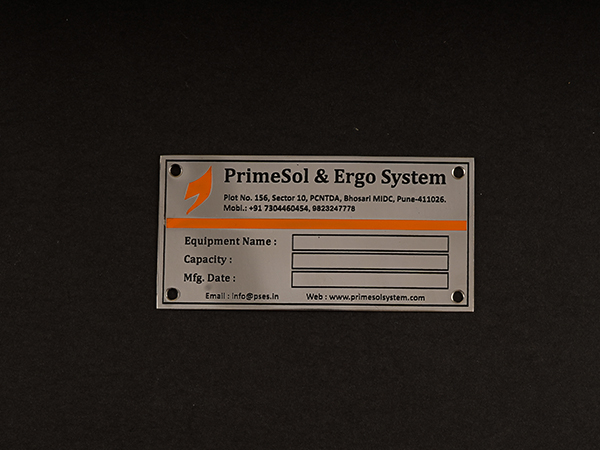 | Metal Labels In the most testing conditions, particularly overwhelming modern situations, where heat, moisture and erosion are available, Stainless Steel... View product → |
Frequently asked questions
Are brass or stainless steel nameplates better for equipment in Bengaluru?
Choose brass for dry, sheltered equipment where its warm appearance suits the installation. Choose stainless steel for equipment exposed to monsoon moisture, frequent cleaning, abrasion or chemicals.
How do brass and stainless steel compare for corrosion and cleaning?
Brass can tarnish and develop surface discolouration in humid or polluted locations. Stainless steel resists corrosion better, but fingerprints, tea staining and contamination still require suitable cleaning and the correct grade.
What should you check before comparing brass and stainless steel nameplate prices?
Check the brass alloy or stainless steel grade, plate thickness, surface finish, marking method, adhesive or fixing holes, protective coating and required service environment.
Which marking method should you specify for an equipment nameplate?
Match the method to wear and chemicals: engraved or etched markings provide physical depth, while printed or anodised finishes provide sharp graphics. Specify minimum character height, contrast and resistance to cleaning agents.