
A fast branding order fails when “polycarbonate sticker” is the only specification: the supplier still needs the film construction, print method, adhesive, finish, service conditions, and artwork data. Use the checklist below to define the part, compare alternatives, prepare production-ready files, and request a quote that does not depend on repeated proof changes.
Key takeaways
- Name the part, dimensions, function and service conditions before requesting a quote.
- Choose polycarbonate film thickness, finish and adhesive for the equipment environment.
- Test adhesion on the actual cleaned surface before approving production.
- Send artwork, quantities, samples and delivery details in one order pack.
Define the Polycarbonate Part Before You Request a Quote
A polycarbonate sticker should identify equipment, carry a serial number or rating, explain an operating step, operate a control panel, or display a product brand. If you are sourcing polycarbonate stickers near Pune, request a polycarbonate film label or graphic overlay—not an unspecified “sticker.”
Describe the construction in your order as follows:
- State the film thickness and whether the part is a flat label, flexible overlay, or thicker piece designed for repeated button pressing, impact, or flexing.
- Specify the face finish: gloss, matte, or textured. This controls glare, fingerprints, and readability.
- State the print side. Reverse printing on the back of clear film protects the graphics beneath the polycarbonate; front printing leaves ink exposed unless you add a coating or laminate.
- Name the adhesive and application surface, such as painted metal, powder-coated steel, plastic, glass, or a curved panel.
- Provide the finished size, corner radius, die-cut shape, holes, windows, domes, and control-panel cut-outs.
- Give the indoor or outdoor use, service-temperature range, UV exposure, moisture, chemicals, and cleaning agents.
- Identify variable information, including barcodes, QR codes, serial numbers, warning symbols, and required language.
Custom polycarbonate stickers are not automatically durable because the word “polycarbonate” appears on the quote. Test the complete printed film-and-adhesive construction against solvents, ammonia cleaners, hydrocarbons, and alkaline products. For regulated equipment, ask whether the specific film, ink, adhesive, and process have UL 969 recognition; the standard does not approve every polycarbonate label.
Choose the Material by Service Condition, Not by Appearance
Choose polycarbonate when the label must function as a durable, tactile interface, not merely display a logo. It suits control-panel overlays, push-button windows, operating instructions, rating labels, serial-number labels, and equipment graphics exposed to handling, moisture, and abrasion.
| Material | Better choice when | Limitation to check |
|---|---|---|
| Polycarbonate | You need a tough, cleanable overlay with printed graphics protected beneath the film; reverse printing resists rubbing and chemical contact. | UV-stabilized grade, ink system, service temperature, and exposure duration determine outdoor life. Large overlays can buckle or lift as polycarbonate expands at about 65–70 × 10⁻⁶/K. |
| PVC or vinyl | You need a flexible, economical decal for short-term branding, walls, vehicles, or gently curved surfaces. | It is a weaker choice for repeated button pressing, abrasion, heat, and long-term dimensional stability. |
| Polyester | You need a thin equipment label with strong dimensional stability, solvent resistance, and sharper small text. | It is less suitable than polycarbonate for tactile overlays or impact-prone interfaces. |
| Aluminium | You need a rigid outdoor nameplate, heat tolerance, or permanent identification on a flat surface. | It cannot provide a flexible membrane-switch-style overlay. |
| Stainless steel | You need exceptional impact, corrosion, and heat resistance in harsh industrial or food-processing areas. | It costs more and is unsuitable for flexible control interfaces. |
| Metalphoto | You need highly durable, sealed anodized-aluminium identification with strong outdoor and abrasion performance. | It is rigid and usually unnecessary for ordinary indoor business polycarbonate stickers. |
Specify temperature range, UV exposure, moisture, chemicals, cleaning method, abrasion, and substrate before approving artwork. An adhesive for powder-coated metal is not automatically right for textured plastic, glass, or low-surface-energy plastic. Ask for the exact film, ink, adhesive, and UL 969 recognition details when equipment certification matters.
Specify the Film, Print Side, Finish, and Adhesive
Specify the film thickness and service rating, not just “polycarbonate.” A thin film suits a conformable label; a thicker film gives a firmer control-panel overlay. State the operating temperature, UV exposure, moisture, cleaners, solvents, and hydrocarbons the finished construction must withstand.
| Detail | Choice to specify | Effect on performance |
|---|---|---|
| Film and print side | Clear polycarbonate; reverse-printed or front-printed | Reverse printing protects ink beneath the film from abrasion. Front printing is easier to inspect but needs a protective coating or laminate. |
| Face finish | Gloss, matte, or fine texture | Gloss gives stronger colour contrast but reflects lamps and windows. Matte reduces glare and fingerprints, improving legibility on control panels. |
| Ink and colour | Opaque white backing, process colours, or Pantone references | White backing prevents a dark panel from reducing contrast. Specify opacity where illuminated symbols or warning colours must remain readable. |
| Adhesive | Permanent adhesive matched to painted metal, powder coat, glass, plastic, or textured and low-surface-energy plastic | The wrong adhesive causes edge lift or peel despite a clean-looking label. State the actual substrate and application temperature. |
| Chemical exposure | Test the printed film and adhesive against the named cleaner or solvent | Bare polycarbonate resistance does not validate the ink or adhesive. Incompatible chemicals can cause cracking, swelling, or print loss. |
For custom polycarbonate stickers, request a construction sample if the part faces ammonia cleaners, alkaline wash, fuel, or repeated wiping. Confirm the minimum application temperature, dwell time, and required pressure; these determine whether the bond reaches full strength before production.
For regulated equipment, ask whether the exact film, ink, adhesive, and process carry the claimed UL 969 recognition.
Prepare the Surface and Test the Application Before Production
Prevent edge lift, bubbles, and premature failure by qualifying the actual surface before ordering business polycarbonate stickers. Adhesive selection must match the substrate, finish, temperature range, curvature, and cleaning chemicals—not just the label material.
1. Wash painted metal, powder-coated panels, glass, and plastics with a residue-free cleaner, then wipe with isopropyl alcohol if the coating manufacturer permits it. Remove oil, silicone, dust, release agents, and loose paint; let the surface dry completely.
2. Check the surface by touch and sight. Powder-coat texture, moulded plastic grain, scratches, rivets, and seams create air paths and reduce contact area. Use a conformable adhesive only when the supplier confirms it suits that texture.
3. Test low-surface-energy plastics such as polyethylene or polypropylene with the proposed adhesive. A label that sticks to glass can lift from these plastics, especially at corners.
4. Apply a sample without stretching it. Use a clean squeegee from the centre outward, maintain firm pressure, and allow the adhesive’s stated dwell time before judging bond strength. Immediate adhesion is not final adhesion.
5. Test curved parts at the real radius, including corners and button wells. Record bubbles, whitening, edge lift, and print distortion after the planned temperature, humidity, UV, and chemical exposure.
Polycarbonate expands about 65–70 × 10⁻⁶/K. Ask for a size and temperature review when the label spans dissimilar materials or a rigid panel; movement can buckle an overlay or stress its printed registration.
Submit a Fast, Complete Order Pack to a Pune Manufacturer
Send a complete order pack to a polycarbonate label manufacturer in Pune, not only a logo and finished size. For buyers comparing polycarbonate stickers near Pune, a controlled specification prevents proof revisions, material substitutions, and missed dispatch dates.
1. Attach vector artwork in AI, EPS, or print-ready PDF format with fonts outlined, actual dimensions, die-cut lines, corner radii, bleed, registration marks, and the required print side.
2. Supply variable data in a locked spreadsheet: serial numbers, ratings, warnings, QR codes, and barcode values. Name the barcode symbology and approve one data sample before production.
3. State film thickness, front or reverse printing, surface finish, print colours or Pantone references, adhesive type, substrate, indoor or outdoor use, operating temperature, chemical exposure, and abrasion conditions.
4. Add compliance evidence to the purchase order. If you need UL 969, ask for the specific film, ink, adhesive, printing process, and application recognition; “UL-approved polycarbonate” is not a complete claim.
5. Give the quantity, delivery address and deadline, split quantities, packing method, and whether “ready to dispatch” is acceptable or the labels must complete application and environmental qualification first.
6. Flag large overlays, rigid panels, curved surfaces, or labels spanning different materials. Polycarbonate moves about 65–70 × 10⁻⁶/K, so the supplier must review dimensional tolerance and edge-lift risk.
Shreeniwas Signs Pvt Ltd can use this same pack to distinguish a quick artwork proof from a production-ready specification, especially where barcode accuracy or outdoor exposure controls the schedule.
Related product
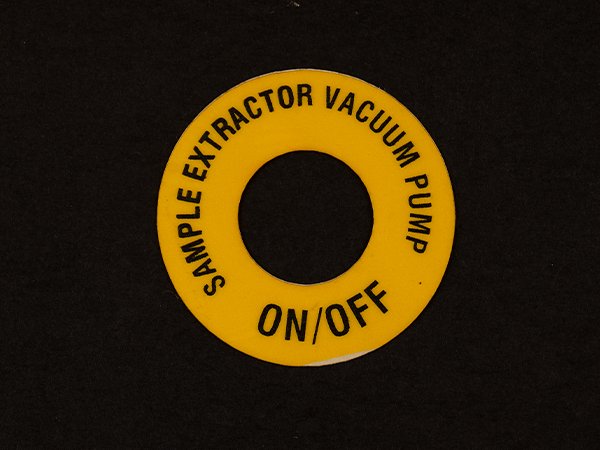 | Plastic Labels PVC & Polycarbonate Stickers are often used in various industries. View product → |
Frequently asked questions
What should you define before requesting a polycarbonate sticker quote?
State whether you need an equipment label, rating plate, serial label, operating instruction, control-panel overlay or brand graphic. Include dimensions, quantities, artwork, cut shape, holes, windows and required markings.
How do you choose polycarbonate sticker material?
Match the film and adhesive to temperature, sunlight, moisture, chemicals, abrasion, cleaning methods and expected service life rather than choosing by appearance alone.
What specifications belong in a polycarbonate sticker order?
Specify film thickness, print side, ink or print method, surface finish, adhesive type, liner, die-cut shape, colour references and any clear windows or tactile features.
How should you test a polycarbonate sticker before production?
Clean the actual application surface, apply a representative sample, allow the adhesive to bond, then check adhesion after exposure to the equipment’s heat, moisture, cleaners and handling.