
A polycarbonate graphic becomes an in-mold decoration only when it is printed, positioned inside an injection mold, and permanently integrated with the molded plastic behind it. The process involves more than sticker printing: you need to specify the film, ink stack, forming method, mold design, resin conditions, inspection criteria, and production volume before choosing it.
Key takeaways
- Place the printed polycarbonate film inside the mold before resin injection.
- Check ink adhesion, film forming limits, resin compatibility, and mold registration.
- Inspect for bubbles, scratches, delamination, distortion, and unreadable graphics after molding.
- Choose IMD for integrated durability; choose conventional labels for low-volume or frequently revised products.
What Makes a Polycarbonate Graphic True In-Mold Decoration
True in-mold decoration places printed polycarbonate film inside the injection mold before resin enters, so the graphic becomes part of the molded component.
A pressure-sensitive polycarbonate label applied after molding remains a conventional label, even when a supplier calls it an “IMD sticker.” Searches for in mold decoration polycarbonate stickers in pune often mix these two processes.
A controlled in mold decoration process in pune follows this sequence:
- Prepare artwork for the finished part, including distortion compensation for formed areas.
- Print the graphic on the reverse side of the polycarbonate film, keeping the visible image protected beneath the film.
- Dry or cure the ink fully so heat and resin do not smear or attack it.
- Die-cut the printed film to the insert outline.
- Preform or thermoform it when the part has deep draws, tight radii, compound curves, or molded-in bosses.
- Register the flat film or preform inside the mold using its locating features.
- Close the tool without shifting, trapping, or wrinkling the insert.
- Inject the resin behind the film, allowing it to bond or encapsulate the graphic.
- Cool the part, then demold it without lifting the film or stressing corners.
- Trim flash and inspect registration, bubbles, wrinkles, print quality, surface defects, and dimensions.
In-mold labeling usually describes a preprinted label placed in a container mold, while IMD commonly uses a decorative film that forms the visible component surface. Over-molding is broader: it may encapsulate a printed film but does not define the construction. Direct printing puts ink on an already molded part, with no film inserted during molding.
How the Film, Ink Stack, and Mold Are Prepared
Choose the film before designing the insert. For polycarbonate stickers manufacturing, specify thickness, surface treatment, optical clarity, surface hardness, dimensional stability, chemical resistance, and the grade’s forming-temperature range. A film that suits a flat indoor label can fail around a radius after contact with oil, cleaner, sunlight, or heat.
Prepare the film and tool against this checklist:
- Print the reverse side so the molded surface protects the graphic from abrasion. Confirm ink compatibility with polycarbonate, the resin, and any forming operation; add an opaque white backing layer when colour density or light blocking is required.
- Dry or cure every ink layer fully before die-cutting or forming. Control moisture using the film supplier’s technical data; excess moisture can cause bubbles, splay, optical haze, and dimensional variation.
- Use flat film directly only on flat or gently contoured parts. Deep draws, tight radii, compound curves, and molded-in bosses require preforming or thermoforming; forcing flat film over them creates wrinkles, bridging, or registration shift.
- Add retaining edges, vacuum ports, or light tacking to stop movement during tool closure. Keep gates, ejectors, weld lines, and critical artwork apart, and provide vents so trapped air does not produce bubbles, silvering, incomplete contact, or print distortion.
- Compensate artwork for forming stretch and shrinkage, then verify registration after forming, not only on the flat print.
A credible in-mold decoration process in Pune treats printing, curing, trimming, forming, insert placement, injection, and inspection as one controlled assembly rather than simply polycarbonate sticker printing.
What Can Fail After the Graphic Is Encapsulated
Encapsulation does not guarantee a durable graphic. Delamination, edge lift, and poor adhesion occur when the film is dirty, moisture-loaded, or poorly bonded; bubbles and wrinkles indicate trapped air or film movement. Ink attack can cause bleeding, while misregistration, warping, cracking, fading, and stress whitening expose limits in printing, forming, or molding.
- Higher injection pressure and melt temperature improve filling behind the film but can cause ink bleeding, film deformation, gloss change, gate read-through, and visible weld lines.
- Differential shrinkage and thermal expansion between polycarbonate and resin can lift edges or distort registration; forming relaxation can add waviness after demolding.
Set the molding window with the actual film-and-ink stack, not the resin supplier’s generic settings. In an in mold decoration process in pune, control dust and monsoon humidity, check protective-film condition, record every material lot and storage age, and measure critical dimensions on first articles.
A clean transfer route between printing, forming, and molding matters as much as the tool.
Qualify production with abrasion, chemical-resistance, UV, humidity, and temperature-cycle testing. Use ASTM D3359 for cross-hatch coating adhesion; it does not prove field life. ASTM D1000 addresses pressure-sensitive adhesive tape constructions, not every encapsulated film. UL 969 evaluates marking and labeling systems for defined end uses, but does not guarantee survival in every Pune installation environment.
Record resin, ink, exposure conditions, and acceptance limits before release.
When IMD Beats a Conventional Label—and When It Does Not
Choose IMD when a repeated molded-part program needs a protected, flush graphic that will survive handling and cleaning. It earns its tooling cost through integrated interfaces, not through one-off sticker production.
| Option | Appearance and durability | Tooling, changeover, geometry and economics |
|---|---|---|
| In-mold decoration | Graphic sits beneath the molded surface, giving a flush finish and strong protection from abrasion and cleaners. | Requires tooling, insert registration and process control; best for repeat production, shaped surfaces and stable graphics. |
| Screen-printed polycarbonate overlay | Durable, attractive and flatter than a vinyl decal, but remains a separate applied layer. | Lower tooling and easier changes; economical for medium batches and flat or gently curved parts. |
| Pressure-sensitive polycarbonate sticker | Good printed detail, but its adhesive edge can collect dirt, lift or show a step. | Fast, flexible and inexpensive for existing parts, repairs and small batches. |
| Vinyl decal | Flexible and low-cost, but less suited to severe cleaning, heat or abrasion. | Minimal tooling and rapid artwork changes; useful for short runs and temporary graphics. |
| Laser marking | Flush and permanent on a compatible molded surface, with limited colour options. | No label tooling and little changeover; unsuitable when full-colour graphics or high contrast on some resins is required. |
| Pad or digital printing on molded parts | Direct finish avoids a label edge, but protection and consistency depend on ink, resin and part geometry. | Suits simple surfaces and small-to-medium batches; complex curves can distort or misregister graphics. |
Choose a post-applied method for prototypes, very small batches, frequently changing graphics, complex undercuts, or existing molded parts. For custom plastic product labels in Pune, a conventional label is faster and cheaper when flush integration adds no functional benefit.
How to Specify and Qualify an IMD Supplier in Pune
Put every requirement on the drawing and purchase order. For custom plastic product labels in Pune, a loose printed-sheet approval is inadequate: forming and molding can shift artwork, distort text, or make a barcode fail verification.
1. Specify the film grade and thickness, print side, ink system, forming operation, molding resin, part geometry, corner radii, surface gloss, viewing distance, minimum text height, barcode symbology, and required verifier grade.
2. Define the artwork-to-part registration tolerance and mark permitted gate and ejector locations. A barcode that scans on a flat sample can become unusable after stretching, while a gate or ejector mark in the viewing area can spoil an otherwise correct part.
3. Record exposure limits for cleaning chemicals, UV, and temperature range. Include monsoon storage controls, protective-film condition, lot traceability, dimensions, print registration, and storage age in incoming inspection.
4. Require the quotation to name who performs printing, forming, tooling, insert placement, injection molding, trimming, and final inspection. Separate transfers add contamination, registration, and traceability risks; the quote should identify each handoff and its inspection record.
“In mold decoration polycarbonate stickers in Pune” should therefore describe an integrated process, not merely sticker printing. Shreeniwas Signs Pvt Ltd is a Pune manufacturer to discuss when you need one accountable review of the printed film, molded integration, inspection records, and traceability rather than a standalone sticker quote.
Related product
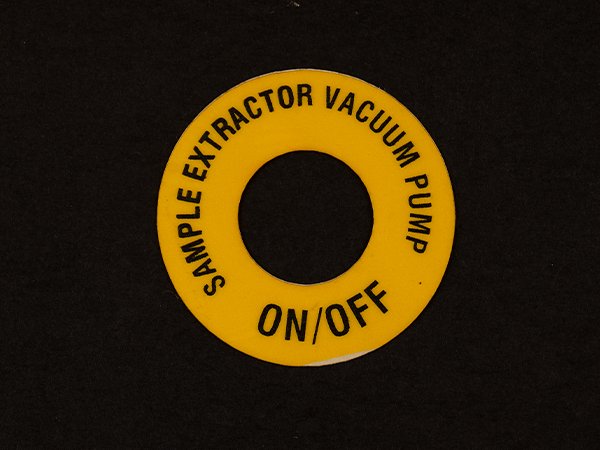 | Plastic Labels PVC & Polycarbonate Stickers are often used in various industries. View product → |
Frequently asked questions
What makes a polycarbonate graphic true in-mold decoration?
The printed polycarbonate film is placed inside the injection mold before resin enters, permanently integrating the graphic with the molded part.
How are the film, ink stack, and mold prepared for IMD?
Prepare the film thickness and forming geometry, validate the ink stack and adhesion, then control placement, registration, cavity cleanliness, and resin compatibility.
What can fail after an IMD graphic is encapsulated?
Inspect for bubbles, wrinkles, delamination, ink attack, scratches, distortion, poor registration, and graphics that become unreadable after forming or molding.
When does IMD beat a conventional label?
IMD suits durable, integrated graphics exposed to handling, cleaning, or abrasion. Conventional labels suit prototypes, low volumes, flat surfaces, or products needing frequent artwork changes.
How should you qualify an IMD supplier in Pune?
Request material and ink specifications, forming and molding samples, process limits, inspection records, traceability details, and test results using your actual resin and artwork.